Subjects





Nora is located on a promontory, the Cape of Pula, separated from the mainland by an isthmus that extends into two points: a O Sa Punta 'e Su Coloru (the tip of the snake), a E la Punta del Coltellazzo, in front of the homonymous island. The area is dominated by the Spanish Coltellazzo tower, in a position of great landscape value.
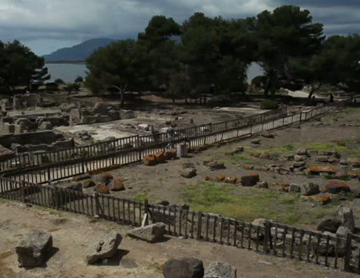
Nora was founded by the Phoenicians, at the end of the 8th or 7th century BC, on the enchanting promontory of the Cape of Pula, between sea and ponds. Currently, in the ancient Phoenician, Punic and then Roman shopping center, we can observe the Phoenician necropolis, the housing complex and the Punic tophet.
Among the ancient streets paved in andesite, you can still admire one of the best preserved buildings in Nora, the beautiful theater, built at the beginning of the first century BC. Impressive are the thermal structures, often decorated with magnificent mosaics dating from between the second and fourth centuries AD. Various religious structures such as the Temple of Tanit from the Punic period, located on the homonymous hill, temple no. 6 or the sanctuary of Asclepius from the 2nd to 3rd century AD. There are also numerous works of private housing, often equipped with a water tank,
built with walls in opus caementicium and africanum, sometimes particularly prestigious, such as the house in the tetrastile atrium, with the suggestive mosaics of the 3rd-4th century AD. Near the sea there is a regular forum, which houses the base of honorary statues of famous people.
After a long period beginning in the 5th century AD, the city was permanently abandoned in the 8th century AD, following frequent pirate and vandalism incursions. From the end of the 19th century, the city was rediscovered, thanks to the investigations of Nissardi and Vivanet and then following the excavations undertaken starting in 1952. From the site of Nora, one of the most important sites in southern Sardinia, comes one of the most important testimonies of Sardinian archeology, the famous Stele di Nora (late 9th-early 8th century BC), in which the oldest attestation of the name Sardinia appears.
History of excavations
The first interventions on the site, in 1889, concerned the tofet, while in the following years the Punic and Roman necropolises and small parts of the town were excavated. After other modest interventions, between 1952 and 1960, Gennaro Pesce highlighted a large part of the Roman town. Since 1990, the site has been affected by continuous systematic excavations by a group of universities.
Bibliography
G. Patroni, "Nora. Colonia fenicia in Sardegna", in Monumenti Antichi dell'Accademia dei Lincei, 14, 1904, coll. 39-268;
P. Bartoloni-C. Tronchetti, La necropoli di Nora, collana "Collezione di Studi Fenici", 12, Roma, 1981;
S. Moscati, Italia punica, Milano, Rusconi, 1986;
P. Meloni, La Sardegna romana, Sassari, Chiarella, 1990;
S. Angiolillo, L'arte della Sardegna romana, Milano, Jaca Book, 1998;
Ricerche su Nora - I (anni 1990-1998), a cura di C. Tronchetti, Cagliari, Sainas, 2000;
C. Tronchetti, Nora. Sassari, C. Delfino, 2001 (Sardegna archeologica. Guide e itinerari; 1);
Nora, area C. Scavi 1996-1999, a cura di B.M. Giannattasio, Genova, Brigati, 2003;
A. Mastino, Storia della Sardegna antica, Nuoro, Il Maestrale, 2005.
Structure category: archaeological area or park
Content type:
Archaeological complex
Archaeology
Usability: Open
Province: Cagliari
Common: Pula
Macro Territorial Area: South Sardinia
POSTAL CODE: 09050
Address: viale Nora, s.n.c.
Telephone: +39 329 6715230 +39 392 0448674 +39 070 9209366
E-mail: bookingnorafp@gmail.com fondazione@comune.pula.ca.it
Special openings: Per avere informazioni sempre aggiornate su costo dei biglietti e orari di apertura si consiglia di visitare la pagina web dedicata del gestore.
Information on tickets and access: For always updated information on visiting hours and ticket costs, we recommend that you visit the manager's dedicated web page. Restrictions: walking on wall structures and mosaics is not allowed. Access in a bathing suit is not allowed. Dogs are allowed to enter as long as they are on a leash.
Access mode: For a fee
Other services: The free Norapp audio guide is also available for Nora's website, downloadable from Google Play and the App Store.
Update
Services
 Bookshop
 Guided tours
 Facilitated physical accessibility for visitors with specific needs
Where is it
Images
Texts

Author : Tronchetti, Carlo
Author : Tronchetti, Carlo
Results 2 of 1391553
View All
Video


 Facebook
 Twitter
 LinkedIn
 Whatsapp

 Print
Print
 E-mail



Comments