Subjects





The church is isolated on a volcanic hill far from the town of Ozieri, from which the surrounding countryside dominates. The place was the seat of the diocese of Bisarchium/Guisarchum documented from 1065-82 and suppressed in 1503. Sant'Antioco di Bisarcio is one of the largest Romanesque churches in Sardinia. The isolation and the scenic position determine a unique combination of landscape and architecture, which qualifies the site as one of the most fascinating in the entire Sardinian architectural landscape.
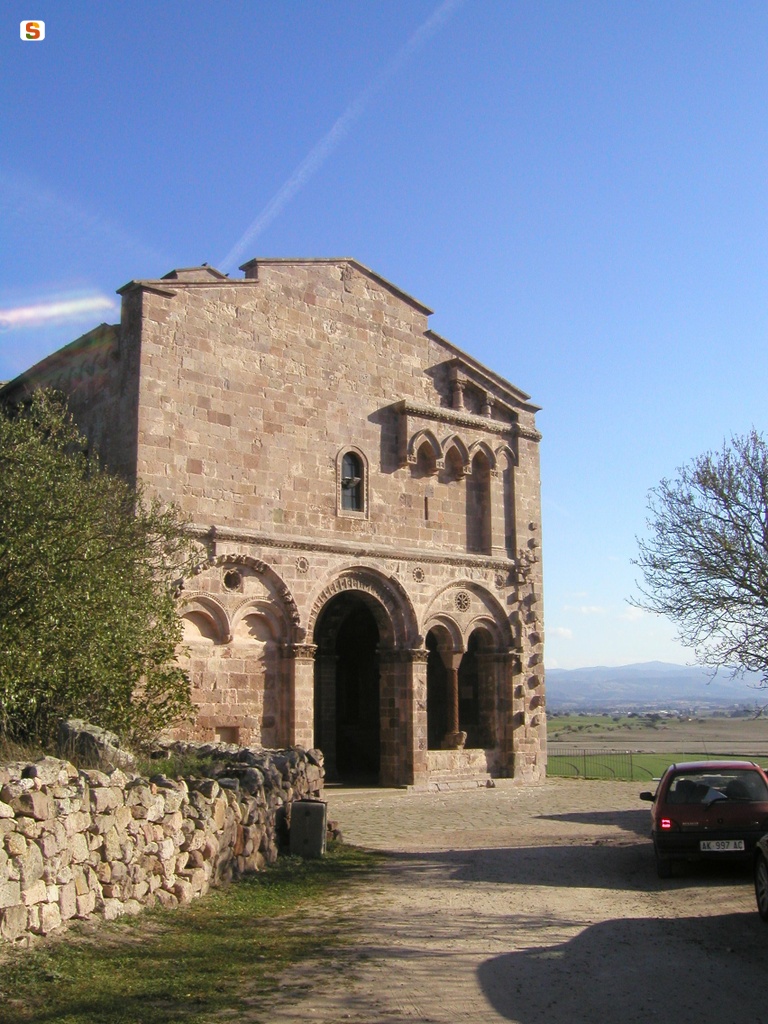
The church (33 x 12 m, height about 10 m) is made of volcanic stone from local quarries. The impressive dimensional development derives from the function of cathedral of the diocese of Bisarcio. The plant dates back to a period before 1090, the year in which an archival document replicates an older act of possession, which was lost in the fire that destroyed the first cathedral. In the current building, there are three factory periods: the rows of freshly drafted cantons go back to the eleventh century, at the base of the walls of the flanks facing E. The second building phase, after the mid-12th century, is characterized by well-shaped medium-sized cantons. The porch was added at the beginning of the 13th century. The left side of the porch, which collapsed, was rebuilt in the 16th century.
The floor plan has a trench with an E-shaped apse. The central aisle has a wooden roof; the lateral ones have a cross shape. The arches of the seven dividers rise on columns with phytomorphic bases and capitals. In the presbytery there are two pillars with a cross-section, one of which holds a capital with an anthropomorphic figuration.
The apse reflects the Pisan ways of the workers active on the island's construction sites in the middle of the 12th century: divided into mirrors by means of semicolumns with vegetable capital, arcatelles inside which are inserted large rhinestones with bichromic steps.
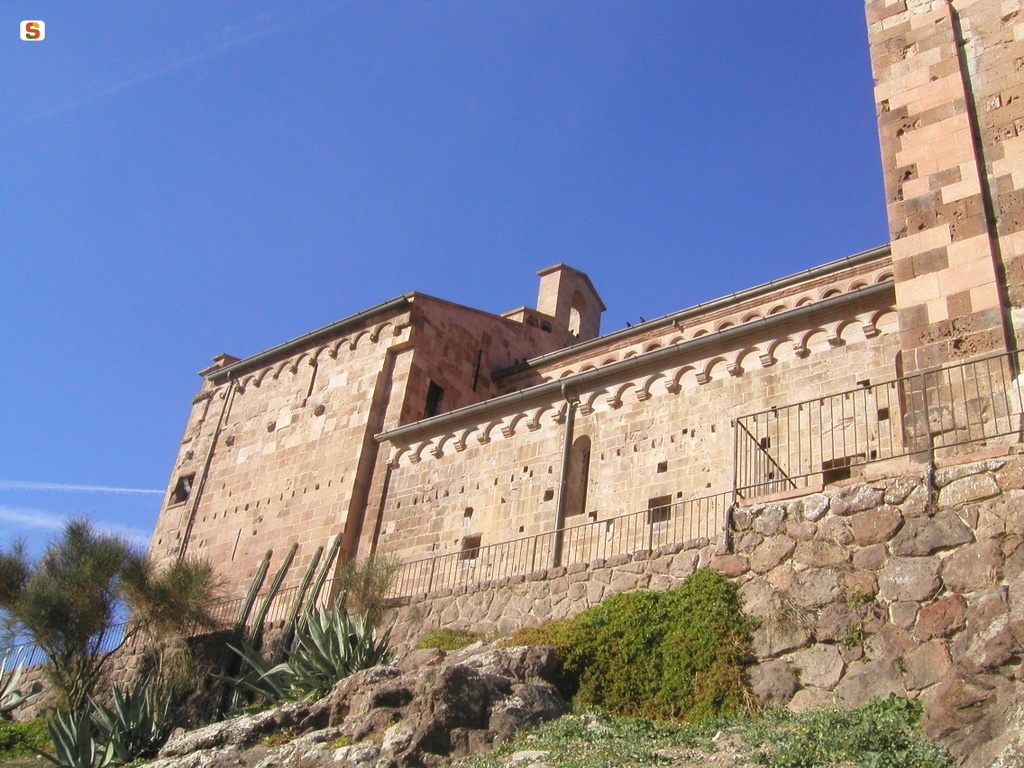
The thirteenth-century porch has six cross-vaulted bays on cruciform pillars. The upper floor of the porch has three barrel-vaulted rooms, one of which overlooks the central aisle. Within these rooms, used as a bishop's chapel and connected to the episcope, there is a path in the shape of a mitre. On the outside, three arches open in the first order; in the second, a series of ovised arches are arranged. In the large side wall, the ashlar cushions on the walls of the episcope, which developed along the right side of the church, are evident.
History of studies
The building is mentioned by Vittorio Angius (1834) and described by Giovanni Spano (1860). Dionigi Scano considers it in his study on medieval Sardinian churches (1907). The modern reading proceeds through the contribution of Raffaello Delogu (1953), passes through that of Renata Serra (1989) and reaches the profile of Roberto Coroneo (1993). Fernanda Poli is responsible for an in-depth study of sculptural decoration (1999).
Bibliography
V. Angius, voce "Bisarcio", in Goffredo Casalis, Dizionario geografico storico-statistico-commerciale degli Stati di S.M. il re di Sardegna, II, Torino, G. Maspero, 1834, pp. 336-337;
G. Spano, "Chiesa e cattedrale dell'antica Bisarchio", in Bullettino Archeologico Sardo, VI, 1860, pp. 81-91;
D. Scano, Storia dell'arte in Sardegna dal XI al XIV secolo, Cagliari-Sassari, Montorsi, 1907, pp. 200-211;
R. Delogu, L'architettura del Medioevo in Sardegna, Roma, La Libreria dello Stato, 1953, pp. 76, 121-125;
F. Amadu, La diocesi medioevale di Bisarcio, Cagliari, Fossataro, 1963, pp. 11-40;
R. Serra, La Sardegna, collana "Italia romanica", Milano, Jaca Book, 1989, pp. 262-270;
R. Coroneo, Architettura romanica dalla metà del Mille al primo '300. Nuoro, Ilisso, 1993, scheda 19;
F. Poli, "La decorazione scultorea del Sant'Antioco di Bisarcio. Nuovi dati per vecchie attribuzioni", in Sacer, n. 6, 1999, pp. 167-199;
G. Piras, "Le iscrizioni funerarie medievali della basilica di San Gavino: contributi preliminari per una rilettura", in Il Regno di Torres 2. Atti di Spazio e Suono 1995-1997, Sassari, 2003, pp. 302-342;
R. Coroneo-R. Serra, Sardegna preromanica e romanica, collana "Patrimonio artistico italiano", Milano, Jaca Book, 2004, pp. 157-166;
R. Coroneo, Chiese romaniche della Sardegna. Itinerari turistico culturali, Cagliari, AV, 2005, pp. 51-52.
Structure category: Monument or Monumental Complex
Content type:
Religious architecture
Usability: Open
Province: Sassari
Common: Ozieri
Macro Territorial Area: Nord Sardegna
POSTAL CODE: 07014
Address: SS 597 - località S. Antioco di Bisarcio
Telephone: +39 079 787638 +39 079 7851052
E-mail: segreteria.istituzione@comune.ozieri.ss.it promozione.istituzione@comune.ozieri.ss.it
Website: www.bisarcio.comune.ozieri.ss.it/index.htm www.welcometozieri.it/joomla/info-e-orari
November - March
Winter - Winter
Tuesday - Wednesday - Thursday - Friday - Saturday - Sunday
09:30 AM - 1:00 PM
Tuesday - Wednesday - Thursday - Friday - Saturday - Sunday
2:00 PM - 6:00 PM
April - October
Summer - Summer
Tuesday - Wednesday - Thursday - Friday - Saturday - Sunday
10:00 AM - 1:00 PM
Tuesday - Wednesday - Thursday - Friday - Saturday - Sunday
2:30 PM - 7:00 PM
Information on tickets and access: Special closures on November 1, December 25 and 26, January 1 and 6. The amount of tickets may have changed. The usability of the site refers to the same municipal structure that manages the Grotta di San Michele, in Ozieri.
Access mode: For a fee
Tickets :
Services information: For educational workshops dedicated to schools, advance booking is necessary, at the San Michele Institution, to define the program of activities and the costs of registration. Guided tours are included in the ticket price.
Update
Services
 Teaching room
 Guided tours
Where is it
Ozieri, Chiesa di Sant'Antioco di Bisarcio Images number: 5
Images


 Facebook
 Twitter
 LinkedIn
 Whatsapp

 Print
Print
 E-mail



Comments