Subjects





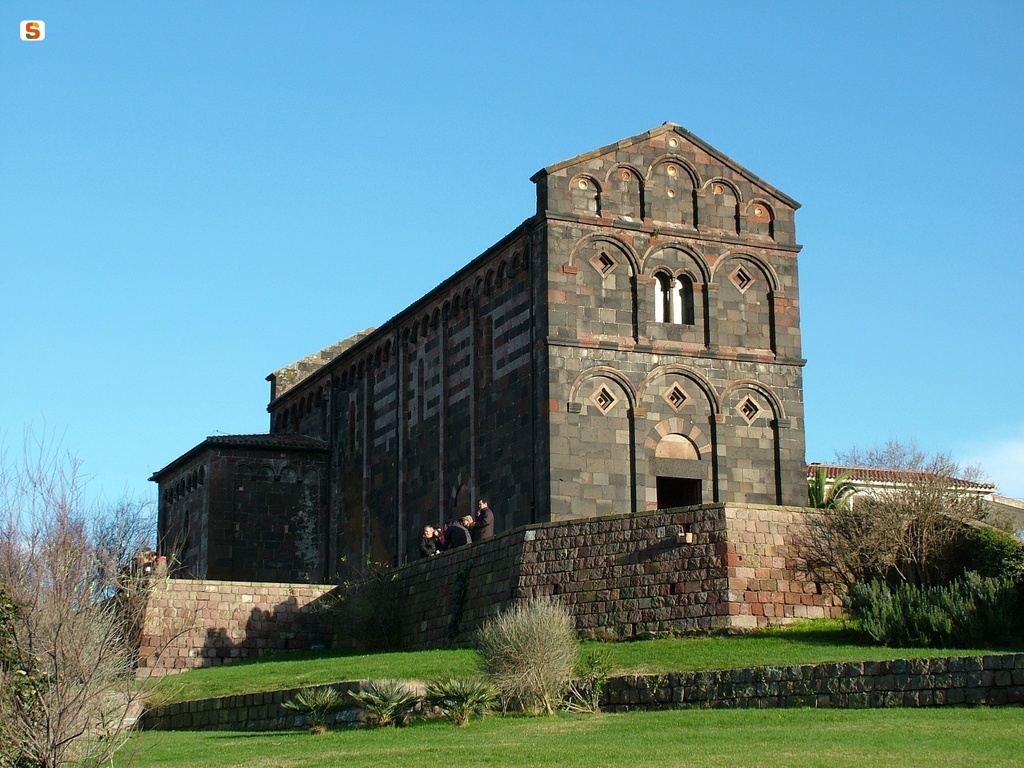
The church is located on the top of the Buon Cammino Hill, close to the homonymous prison. It was originally named after San Pancrazio, then in Spanish times to San Lorenzo or to the Madonna del Buongiorno, as travelers stopped there for a propitiatory prayer, before embarking on the long journey inside the island.
The church of San Lorenzo is one of the least known monuments of medieval architecture in Cagliari, but not devoid of interest and the suggestion that in this case can come mainly from the inside, collected and pervaded by a discreet and diffused light.
Documentary information on the plant is missing, but the building type makes it possible to hypothesize that it dates back to the first quarter of the 12th century. The floor plan has two naves divided by sturdy arches on squat columns. The naves are barreled and reinforced by undergarches. The walls are made of medium-size limestone blocks.
In the 18th century, the original façade was destroyed to build an atrium; side chapels were opened and the apses were eliminated. The old façade is survived by the bell tower and a series of cantons used to house ceramic basins. There are 48 lodgings but only two ceramic basins are preserved. Although fragmentary, they allow one to be recognized as a Maghrebin-Islamic production, the other as a protomaiolic of southern Italy.
History of studies
The church is mentioned by Vittorio Angius (1836) and in the “Guide” by Canon Giovanni Spano (1861). The first historical and artistic studies were by Raffaello Delogu (1953) and Bruno Virdis (1962). After Renata Serra's paper (1989), Maria Francesca Porcella (1990) studies ceramic basins. The most recent contribution is by Roberto Coroneo (1993).
Bibliography
V. Angius, entry “Cagliari”, in G. Casalis, Historical and Statistical-Commercial Geographical Dictionary of the States of His Excellency the King of Sardinia, III, Turin, G. Maspero, 1836, p. 209;
G. Spano, Guide to the city and surroundings of Cagliari, Cagliari, Typography A. Timon, 1861, pp. 356-359;
R. Delogu, The Architecture of the Middle Ages in Sardinia, Rome, The State Library, 1953, pp. 53-59; B. Virdis, “Reliefs of three Sardinian churches”, in Palladio, XII, 1962, pp. 86-89; C. Maltese-R. Serra, “Episodes of an Anti-Classical Civilization”, in Sardinia, Venice [1969], republished in Art in Sardinia, Milan, Electa, 1986, p. 211;
M. Botteri, Guide to medieval churches in Sardinia, Sassari, Chiarella, 1978, pp. 32-33;
A. Piseddu, “The Temple on the Hill”, in Almanacco di Cagliari 80, Cagliari, 1979, without pages;
R. Serra, Sardinia, series “Romanesque Italy”, Milan, Jaca Book, 1989, pp. 338-339; M.F. Porcella, Ceramic basins of the church of San Lorenzo in Cagliari and reinterpretation historical-architectural of the building”, in Cagliari. Homage to a city, Oristano, S'Alvure, 1990, pp. 43-54;
R. Coroneo, Romanesque architecture from the middle of the thousand to the early '300, Nuoro, Ilisso, 1993, page 68; Roberto Coroneo, Romanesque churches of Sardinia. Cultural tourist itineraries, Cagliari, AV, 2005, p. 92.
Content type:
Religious architecture
Province: Cagliari
Common: Cagliari
Macro Territorial Area: South Sardinia
POSTAL CODE: 09123
Address: via Santi Lorenzo e Pancrazio, s.n.c.
Update
Where is it
Images
Texts

Author : Porcella, Maria Francesca
Author : Porcella, Maria Francesca
Results 2 of 1354063
View All
Video


 Facebook
 Twitter
 LinkedIn
 Whatsapp

 Print
Print
 E-mail
Comments