Subjects





Fertilia is one of the founding cities built during fascism and its story began in 1933 with the complete remediation of the Nurra by the Ferrarese Colonization Authority (then the Sardinian Colonization Authority). In reality, interest in that area dates back at least to 1898 with the clearing of the Calik pond, carried out with forced labor, to continue with the working-class villages located on the road between Alghero and Porto Conte and the Barezza farm, linked to the artificial lake of Baratz, both dating back to 1927. Among the new cities of the Ventennio, Fertilia is certainly the one that has remained closest to the original rural village.
The urban plan, prepared in 1935 by the engineer Arturo Miraglia, was based on the model of the city spread over the territory, taken from the English experiences of the garden city, but later the commission for a new plan was entrusted to four architects grouped under the acronym 2PST (Concezio Petrucci, Emanuele Filiberto Paolini, Riccardo Silenzi, Mario Tufaroli Luciano).
The new planning tool, approved in 1937, used Miraglia's semicircular pattern as an initial starting point, but accompanied by an orthogonal mesh with a clear separation of public spaces related to the three religious, civic and commercial areas. Even the residential part went from the proposal of houses scattered in the green to an autonomous nucleus, however never built.
After the start of the executive project in 1939, the works continued, before stalling in 1942 due to the increasingly tragic situation of the Second World War, and were resumed only in the 1950s, when the Fertilia settlement prepared to receive refugees from Italian lands that had passed to what had become the federal republic of Yugoslavia, inserted in the Soviet orbit.
The only building in Miraglia actually built between 1935 and 1936, the year the new settlement was inaugurated, is the elementary school, which is influenced by precise references to international experiences and uses volumes with curved lines and ribbon windows with bands of bricks alternating with bands of plaster.
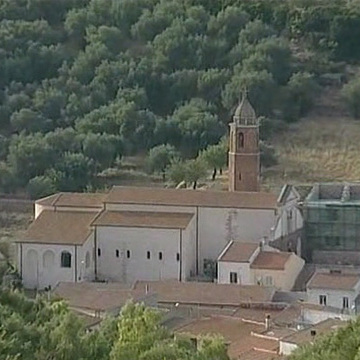
The other architectures, on the other hand, are markedly different and more traditional, starting with the church that takes up the model of the building already built by the same 2PST group in Aprilia, one of the new cities in the Pontine countryside. It has a façade closed by a deep recess that includes the entrance and a window, and is connected to two lower symmetrical elements by arches arranged on curved lines. The tall bell tower was added only in 1955. The building is located in a square and is the visual hub of the main street.
This road crosses the entire center and is lined with porch buildings that, near the sea, open into a space overlooking the municipal house, also with clean and square volumes, the after-work, the hotel.
All the main buildings of Fertilia use exposed or plastered brick and stone, taking up formal elements that were very common in the fascist twenty years and also present in the founding cities of the Agro Pontine.
History of studies
A review of the studies can be found in the bibliography relating to the sheet in the volume of “History of Art in Sardinia” on nineteenth-century architecture (2001).
Bibliography
R. Mariani, Fascismo e "città nuove", Milano, Feltrinelli, 1976;
R. Martinelli-L. Nuti, "Le città nuove del ventennio da Mussolinia a Carbonia", in Le città di fondazione, Venezia, Marsilio, 1978, pp. 271-93;
Fertilia: un'ipotesi di recupero del moderno, Alghero, 1995;
G. Peghin-E. Zoagli, "Fertilia: storia e fondazione di una città moderna", in Le città di fondazione in Sardegna, a cura di A. Lino, Cagliari, Cuec, 1998, pp. 164-176;
F. Masala, Architettura dall'Unità d'Italia alla fine del '900. Nuoro, Ilisso, 2001, schede 112-113;
Città di fondazione italiane 1928-1942, Latina, Novecento, 2005, pp. 275-279.
How to get there
Fertilia is a few kilometers from Alghero, and can be reached along the road of Via Lido and then Viale I Maggio heading north.
Update
Alghero-Fertilia, City of foundation Images number: 16
Images
Audio


 Facebook
 Twitter
 LinkedIn
 Whatsapp

 Print
Print
 E-mail


Comments