Subjects





*Candelaus* belong to the category of *druccis finis*—fine pastries from the Campidano tradition—and, due to their complex preparation and ceremonial significance, stand as one of the most emblematic products of the entire Sardinian confectionery tradition. Their primary production area is the Campidano region, with local variations found in towns across the Middle and Lower Campidano. Although the name derives from the Latin *kalendae*—referring to the Feast of Candlemas on February 2nd—their preparation is not limited to this occasion; *candelaus* are served at solemn ceremonies of all kinds, serving as a special-occasion treat rather than an everyday snack.
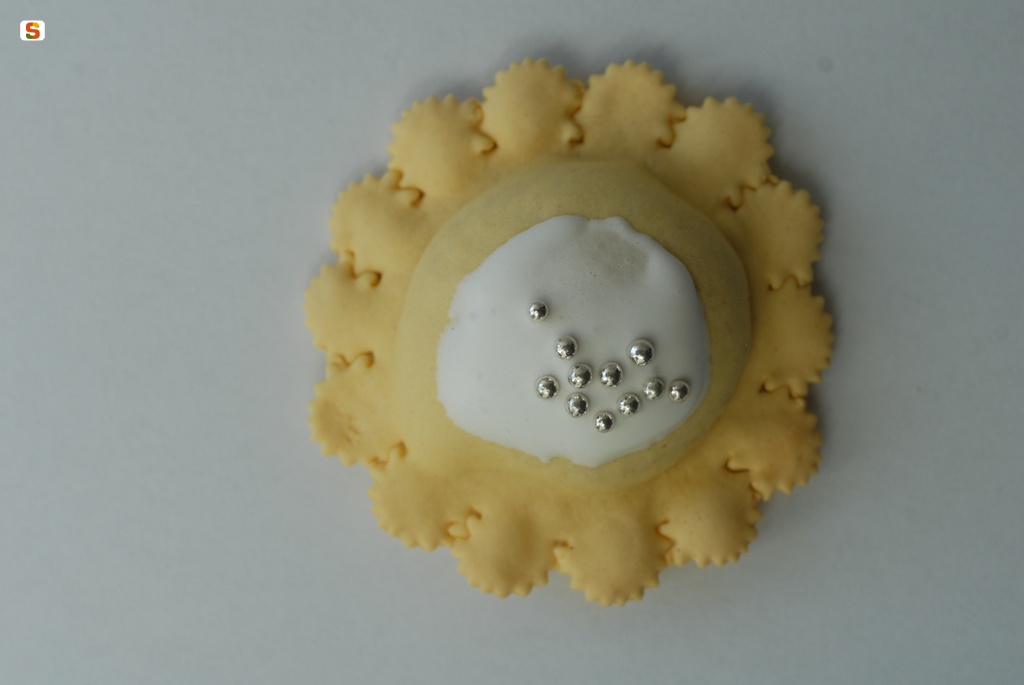
The primary ingredient is almond paste, made from ground almonds, sugar syrup, and orange blossom water. The mixture must be firm enough to be molded without cracking during shaping. The most common shapes include baskets, flowers, fruit, and animals; each is crafted either freehand or using molds made of terracotta, plaster, or wood. When a filling is included, it is also made of almonds but has a softer consistency than the outer shell.
Finishing is the most delicate stage of preparation. First, the *candelau* is brushed with a water-and-sugar glaze that prepares the surface for decoration. Royal icing—a thick, white mixture of egg white, powdered sugar, and lemon juice—is then applied using a paper piping cone. Common decorative motifs include fine lines, geometric patterns, floral designs, initials, and monograms. *Candelaus* are officially recognized as a "Traditional Agri-food Product" under Italian regulations. Historically produced by wealthy families who owned their own almond groves, they are now made by artisanal pastry shops and a small number of home bakers.
Bibliography
U. Dessy, Sardegna: segni della cultura popolare. Quartu Sant’Elena, Alfa Editrice, 1983.
M. L. Wagner, La vita rustica della Sardegna riflessa nella lingua. Nuoro, Ilisso, 1996.
La cucina delle festività religiose. Milano, Accademia Italiana della Cucina, 2010, pp. 343-360.
Dolci in Sardegna. Storia e tradizione. Nuoro, Ilisso, 2011.
G. Marongiu, Mandigos, gustos e licanzas. Selezione di ricette della tradizione orale della Sardegna. Vol. 1, Cagliari, Agenzia LAORE, 2020.
Mandorlicoltura in Sardegna. Le varietà autoctone della Sardegna. Cagliari, Agenzia LAORE, 2021, pp. 40-57.
S. Paulis, Dolci in Sardegna. Nuoro, Ilisso, 2024.
Update
Images
Audio


 Facebook
 Twitter
 LinkedIn
 Whatsapp

 Print
Print
 E-mail


Comments