Subjects





Arborea, located at the center of the vast clean-up of the area south of Oristano, was founded as Villaggio Mussolini, inaugurated by King Vittorio Emanuele III in 1928, but two years after the inauguration it became a municipality with the name of Mussolinia to take its current name in 1944 following the fall of fascism.
The town is closely linked to the great operation to clean up the Oristano swamps and is one of the many projects prepared before the Great War, started at least in 1911 in the aspirations and intentions of a member of Terralba, Felice Porcella. It was then the Sardinian Reclamation Company, with the engineer Giulio Dolcetta and with the financial initiative of the Commercial Bank of the Bastogi group, that carried out the company with a vast movement of men and vehicles.
This was a large and complex intervention aimed at rationalizing the territory, especially for the countryside and its productive potential. In addition to the remediation, which gradually recovered hectares to be cultivated and irrigated with the two water pumps specially designed for the “redemption” of the land, a series of rural villages were built, which then had a service center in the town of Albirdis, called Villaggio Mussolini.
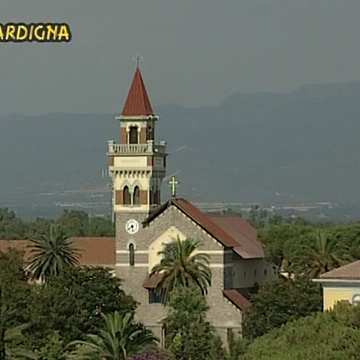
It was an aggregation of buildings without a real urban design and revolving around the church dominated by a bell tower where the significant inscription RESURGO stood out.
The religious building, dedicated to the Redeemer, occupies the short side of the square, while all the other buildings are placed perpendicularly: on one side the elementary schools and a two-family house for employees, on the other the Locanda del Gallo Bianco and the shopping building. In front of the town hall with the house of the reclaiming director and the building of the S.B.S.
All these buildings have an architecture with vaguely “mountain” and picturesque characters in a completely flat area like the Sassu Reclamation. This language is also used in the cemetery enclosure with two-tone bands and towers with sloping roofs in a historicist style. With the exception of the church, designed by G. Bianchi and completed in 1928, the other buildings were designed by the engineer Carlo Avanzini, who died prematurely in 1932.
From an architectural point of view, therefore, there was a change with the series of works designed by the engineer Giovanni Battista Ceas according to a now rationalist language: the house of the table and the house of the bundle, and, shortly after, the barracks of the Voluntary National Security Militia, but less interesting.
Finally, we can mention the late Cooperator's House, now inaugurated in 1960, the work of a fourth designer, the engineer of Dalmatian origin, Nino Cerlienco, who has a simple, but now outdated language, based on the use of local trachyte and the dispersion of dark basalt fragments in the body of heavy masonry.
History of studies
A review of the studies can be found in the bibliography relating to the sheet in the volume of “History of Art in Sardinia” on nineteenth-century architecture (2001).
Bibliography
M. Vinelli, "Mussolinia, nuovo Comune di Sardegna", in Mediterranea, 4, 1931, pp. 6-19;
S. Rattu, "Mussolinia di Sardegna", in Urbanistica, 1, 1939, pp. 40-46;
R. Mariani, Fascismo e "città nuove", Milano, Feltrinelli, 1976;
R. Martinelli-L. Nuti, "Città nuove in Sardegna durante il periodo fascista", in Storia Urbana, II, 1978, 6, pp. 291-324;
P. Ibba, "Le prime esperienze del razionalismo in Sardegna. La città nuova di Mussolina", in Studi Sardi, XXVIII, 1988-89, pp. 443-457;
G. Pellegrini, "L'eccezione e la regola: Eclettismo, Macchinismo e Razionalismo nelle architetture di Mussolinia di Sardegna", in Studi Sardi, XXXI, 1997-98);
G. Pellegrini, "Mussolinia di Sardegna", in Le città di fondazione in Sardegna, a cura di A. Lino, Cagliari, Cuec, 1998, pp. 133-138;
Resurgo. Da Mussolinia ad Arborea: vicende e iconografie della bonifica, a cura di G. Pellegrini, Cagliari, Janus, 2000;
F. Masala, Architettura dall'Unità d'Italia alla fine del '900. Nuoro, Ilisso, 2001, scheda 108;
Città di fondazione italiane 1928-1942, Latina, Novecento, 2005, pp. 251-259.
Update
Images

Author : Leporati, M.
Year : 1928
Author : Leporati, M.
Year : 1928
Results 2 of 132072
View All
Texts
Video
Audio
Author : Mocco Roberta
Results 2 of 13899
View All


 Facebook
 Twitter
 LinkedIn
 Whatsapp

 Print
Print
 E-mail
Comments