Subjects





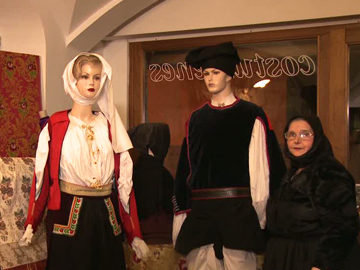
The Osilese wedding dress is one of the richest and most aesthetically suggestive of the entire traditional Sardinian landscape. The specimen described, dating back to the end of the 19th century, belongs to the ISRE (Higher Regional Ethnographic Institute) and is exhibited at the Nuoro Costume Museum.
Like other dresses inaugurated on the occasion of the wedding, it was also reserved for further gala occasions.
This is a type of clothing made of precious fabrics such as silk satin and silk velvet (velvet). It also abounds in floral motifs embroidered with polychrome silk threads and gold and silver tinsel.
One of the most characteristic details is the set of two headpieces. The first is an embroidered white tulle veil, arranged in such a way as to frame the face and descend to partially cover the chest. Superimposed on this first element is the characteristic red velvet cloak in the shape of a semiluna, as it happens, finished with a large white satin frame embroidered with silk threads with flowers of various colors and bordered with a beige velvet.
The jacket, called su grupitu, is made of red velvet, closed on the front with automatic buttons. The long embroidered cuffs hang like butonera, a row of ten or eleven silver filigree buttons on each side.
The bust (s'imbustu), of white satin embroidered with gold threads, is made stiff thanks to the insertion of palm slats and two small iron slats on the sides. On the front it is tied with a system of satin ribbons.
The skirt (flap) is made of garnet red velvet, curled at the waist. On the lower part, it has a large white satin ruffle, embroidered with silk thread with phytomorphic patterns, similar to the mantle.
The type of clothing described above greatly impressed travelers who visited the island in the 19th century. Among these, the Jesuit Antonio Bresciani, who, in the work entitled “Of the customs of the island of Sardinia compared to the very ancient Eastern peoples” (1850), saw “the clothing of the tenth and eleventh centuries with their bandages on their heads, and with the subject like the abbesses [...] of the cloisters”.
Update
Picture gallery Images number: 17
Attachments
Images


 Facebook
 Twitter
 LinkedIn
 Whatsapp

 Print
Print
 E-mail
 Osilo women's gala dress




Comments