Subjects





The archaeological area is located in the hinterland of the Gulf of Asinara, in northern Sardinia.
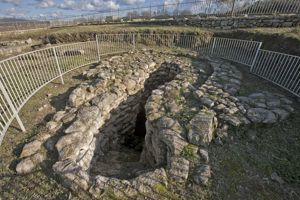
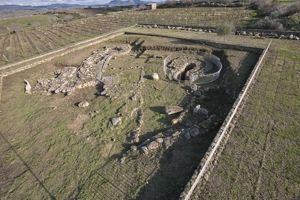
The complex includes a sacred well around which there are an isodomed building and several huts built in later times.
The well temple consists - according to recurring architectural modules in this type of monument - of a circular cell accessible by means of an O-shaped staircase; the building does not have, on the contrary, the vestibule that generally precedes the stairwell.
The well chamber (diam. m 2), covered with “tholos” and today raised (maximum remaining height m 4.40), is dug into the rock and has a slightly concave and rather irregular floor.
The staircase (width 1.20 m; length 3.35 m; depth 3.30 m) descends to the room with fourteen steps, eleven of which are made of limestone slabs and the last three dug into the rock.
The room, today without a roof, follows a semicircular pattern, unusual in this type of monument.
About seven meters from the well, in the N direction, is the building in isodoma construction.
The building, preserved for a single row, has a large circular chamber (diam. m 6), from which a trumped corridor (length m 9) branches off. It is difficult to say what the function of the building was.
Between the two main monuments, there is a cylindrical limestone monolith (diam. m 0.80; height m 0.55), without the upper part and perhaps interpretable as an altar.
An additional structure is present at the SW limit of the archaeological area: it is a tank dug into the rock and reused, perhaps in the Middle Ages, as other buildings develop beyond the excavated area, documenting the complex articulation and extension of the site.
The complex dates back to the end of the Middle Bronze — Recent Bronze — Final Bronze — early Iron Age.
The archaeological material found during the excavations - especially around the monolith - consists of bronze votive objects (some figures of bidders and offerings), bone remains of sacrificed animals and materials from the Roman age that testify to the prolonged use of the area.
History of excavations
The site was excavated in 1985-1988 by Daniela Rovina.
Bibliography
D. Rovina, “Sorso (SS): Temple by well in the Serra Niedda Sanctuary”, in the New Sardinian Archaeological Bulletin, 2, 1985, p. 276 ff.;
D. Rovina, “The Nuragic Sanctuary of Serra Niedda (Sorso)”, in New Sardinian Archaeological Bulletin, 3, 1986, pp. 37-47.
How to get there
Exit from Sassari and take the S.S. 200 to Castelsardo. After passing the town of Sorso, continue for about 2 km until you reach the nuragic sanctuary.
Content type:
Archaeological complex
Archaeology
Usability: unmanaged site
Province: Sassari
Common: Sorso
Macro Territorial Area: Nord Sardegna
POSTAL CODE: 07037
Address: SS 200 - via Castelsardo
Information on tickets and access: Before visiting the archaeological site, it is advisable to contact the town of Sorso, as the gate is closed for security reasons.
Update
Where is it
Images
Video


 Facebook
 Twitter
 LinkedIn
 Whatsapp

 Print
Print
 E-mail


Comments