Subjects





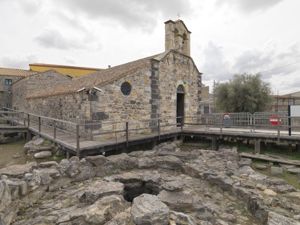
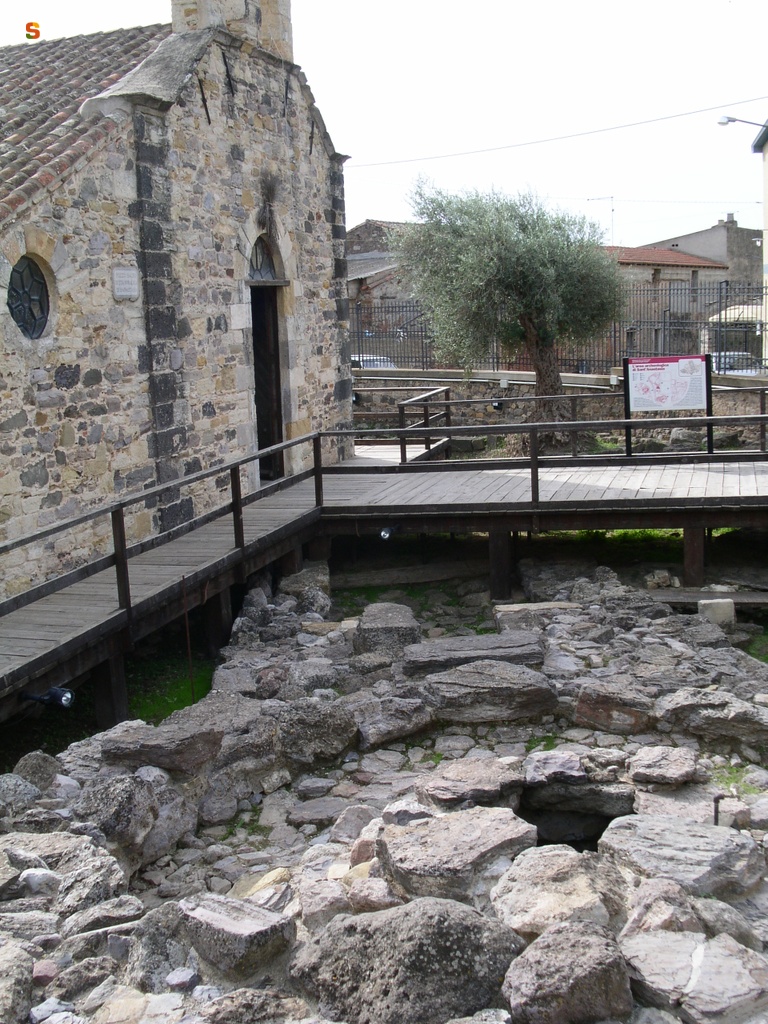
The archaeological area of Santa Anastasia is located near the homonymous church, in the upper part of Sardara, at the foot of the ridge that rises to the hill of Pran'e Cuaddus, in the central Campidano. The nuragic sanctuary has the well temple as its fulcrum and is inserted in an articulated civil and religious settlement still under excavation. It includes, about 10 m S from the first well, a second sacred well and part of a large curvilinear enclosure, inside which the remains of several huts can be found. Inside the church dedicated to S. Anastasia, on the other hand, there is a useful nuragic well, originally inserted in a village hut.
The sanctuary, one of the most important in Nuragic Sardinia, has as its fulcrum the temple a well.
This is made of basalt and limestone blocks and is oriented in the N-E/S-O direction. It consists of a partially paved atrium with seats (m 3.50 x m 2.20), a staircase of 12 steps protected by a narrow corridor and a degrading flat roof (length m 2.20), and a circular chamber with a “tholos” roof (diameter at the base m 3.55; height m 5.05), which can be accessed, from the last step, with a jump of 1.10 m. The spring vein, channeled into a tunnel 5-6 m long, came from an opening equipped with an lintel at the base of the well chamber, on the opposite side of the staircase.
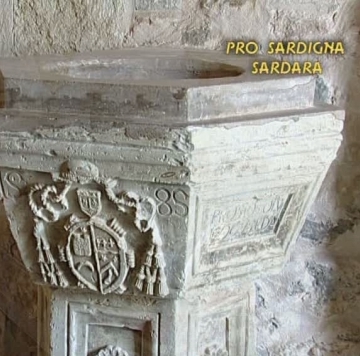
The temple, dated to the late Bronze Age (XIII-XII century BC), is inserted in an articulated civil and religious settlement still under excavation. It includes, about 10 m S from the first well, a second sacred well, in an isodome work, of which some ashlars - decorated with engraved and cantilever motifs or mammillary drafts in relief, one in the shape of a bullfighting protome - are walled up in the façade of the church of Sant'Anastasia.
The excavations have also highlighted the stretch of a large curvilinear enclosure, similar to the “party fence” of the Nuragic sanctuary of Serri, flanked - in part - by a counter of shale slabs, probably connected with a porch.
Inside the enclosure, the remains of several huts can be found. One of these, the “hut 5", equipped with a seat counter and two large rectangular niches, had in the center a sandstone column surmounted by two discs that supported an altar in the shape of a nuragic tower. At the entrance, a rectangular pit dug into the rock counter contained a jar full of bronze artifacts, including foundry tools for craft activities and fragmentary material intended to be reused. Next to the jar, three beautiful bronze basins were found.
The hut, probably a “meeting room” for the village chiefs, was built at the end of the Final Bronze Age (late 11th-10th century BC), while the materials of the closet were hidden there between the end of the 8th century BC and the beginning of the 7th century BC.
At the threshold of the “hut 1", also from the final Bronze Age, a fictile bowl was found containing ingots of the “ox-hide” type, laid in the Iron Age.
The discovery of terracotta fusion matrices in the area outside the “hut 4" testifies to the production of metal products on site.
Inside the church, on the other hand, there is a customary nuragic well, originally inserted in a village hut, which has returned materials dating back to between the Final Bronze and the 7th century BC.
The use of the area for religious purposes has therefore persisted after Nuragic times, as documented by the scarce but significant Punic ceramics found in excavations and the remains of the Byzantine building (named after Saint Anastasia of the Greek menologue) below the church, which is visible today and dates back to the 15th century.
The finds of Sant'Anastasia are exhibited at the Sardara Civic Museum “Villa Abbas” and at the National Archaeological Museum of Cagliari.
History of excavations
The area was excavated several times, starting in 1913, when Antonio Taramelli carried out the first interventions. Other excavation campaigns were conducted in 1980-84 by Giovanni Ugas in collaboration with Luisanna Usai, in 1988 by Giovanni Ugas and in 2000-01 by Roberto Sirigu in collaboration with Donatella Cocco.
Bibliography
A. Taramelli, "Il tempio nuragico di S. Anastasia", in Monumenti Antichi dei Lincei, XXV, 1918, coll. 5-106;
D. Casti, Sardara. Il culto delle acque. Il pozzo sacro di Sant'Anastasia e la sua chiesa, Firenze, Il punto, 1982;
G. Ugas-L. Usai, "Nuovi scavi nel Santuario Nuragico di S. Anastasia di Sardara", in Un millennio di relazioni fra la Sardegna e i paesi del Mediterraneo. Atti del II Convegno di studi (Selargius-Cagliari, 27-30 novembre 1986), Cagliari, Provincia di Cagliari-Assessorato alla Cultura, 1987;
G. Ugas, "Sardara (Cagliari) Località di Sant'Anastasia. Area del Santuario nuragico", in Bollettino di Archeologia, 3, 1990, pp. 144-145;
R. Sirigu, "Sant'Anastasia: storia degli scavi", in Archeologia a Sardara. Da S. Anastasia a Monreale, collana "Quaderni didattici", 11, Cagliari, Soprintendenza archeologica per le province di Cagliari e Oristano, 2003, pp. 7-15;
L. Usai, "Sant'Anastasia: l'area archeologica", in Archeologia a Sardara. Da S. Anastasia a Monreale, collana "Quaderni didattici", 11, Cagliari, Soprintendenza archeologica per le province di Cagliari e Oristano, 2003, pp. 16-40.
How to get there
The town of Sardara, halfway between Cagliari and Oristano, is surrounded by the SS 131, the main road artery in Sardinia. The archaeological area is located in the historic center of the town.
Structure category: archaeological area or park
Content type:
Archaeological complex
Archaeology
Usability: Open
Province: South Sardinia
Common: Sardara
Macro Territorial Area: South Sardinia
POSTAL CODE: 09030
Address: vico Eleonora D'Arborea, 10
Telephone: +39 070 9386183 +39 350 1099278
E-mail: archiviovillaabbas@gmail.com coopvillabbas@tiscali.it
Website: www.comune.sardara.su.it/it/viveresardara/il-museo-archeologico-villa-abbas villaabbas.wordpress.com
Facebook: it-it.facebook.com/villaabbas
October - April
Tuesday - Wednesday - Thursday - Friday - Saturday - Sunday
10:00 AM - 6:00 PM
Maggio - September
Monday - Tuesday - Wednesday - Thursday - Friday - Saturday - Sunday
10:00 AM - 7:00 PM
Special openings: Visits, outside the indicated times, are only possible by reservation.
Information on tickets and access: To visit the archaeological area of Sant'Anastasia, it is necessary to refer to the Civic Archaeological Museum “Villa Abbas”.
Access mode: For a fee
Tickets :
Update
Services
 Guided tours
Where is it
Sardara, Area archeologica di Santa Anastasia Images number: 6
Images
Video


 Facebook
 Twitter
 LinkedIn
 Whatsapp

 Print
Print
 E-mail


Comments