Subjects





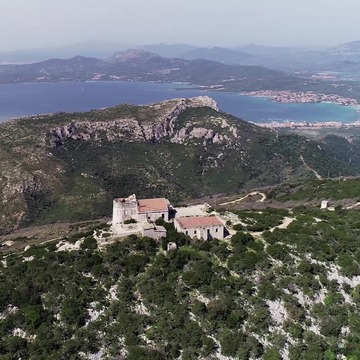
The village is located on a basaltic plateau with pastures, dotted with nuraghi.
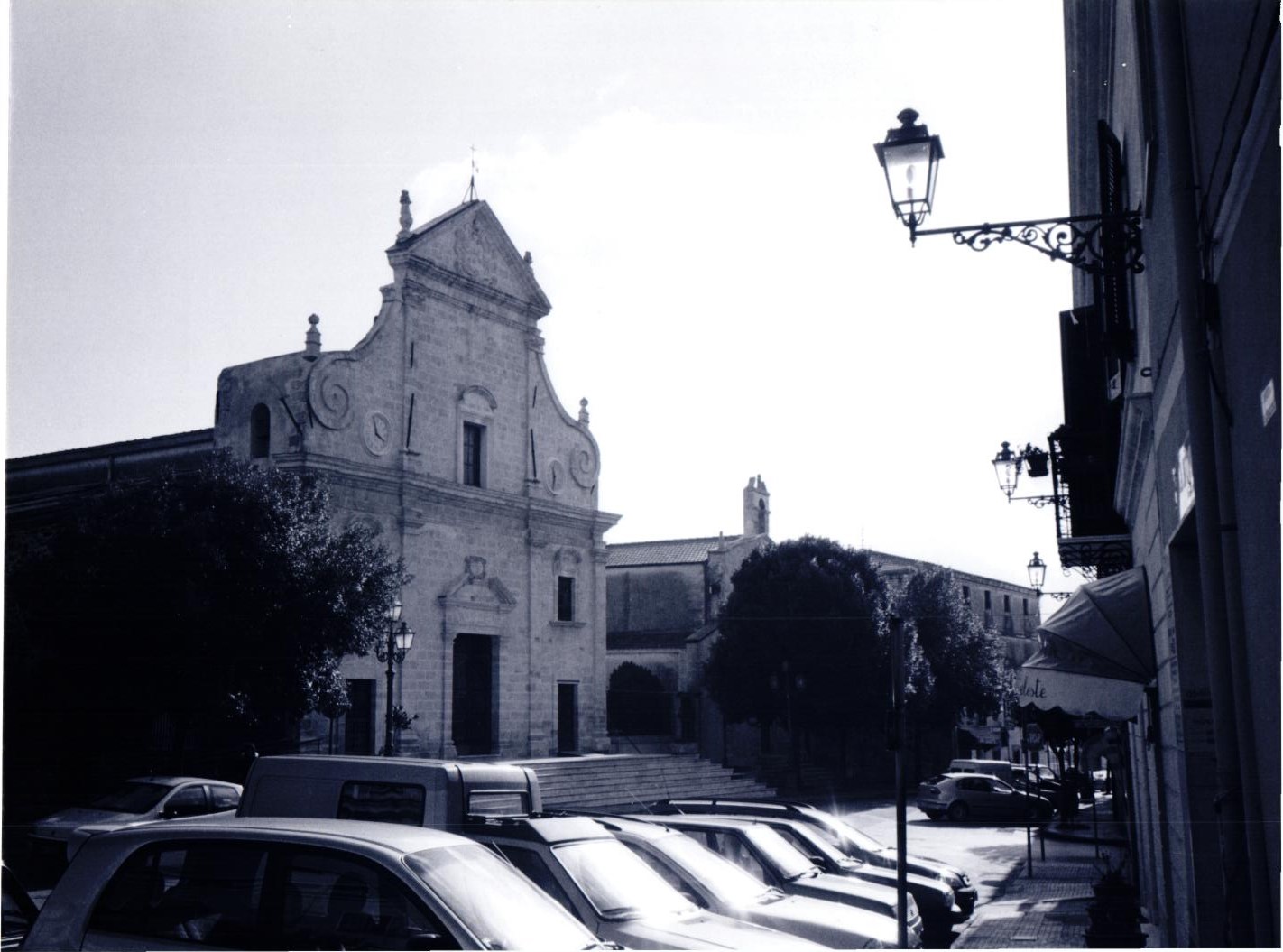
The parish church was rebuilt in 1520, as we read on the façade, by the Baron of Bonvehì Bernardino de Ferrera, the noble Alghero lord of the County of Monteleone, and the bishop of Bosa Pietro de Sena, to whose diocese the Pievania of Padria belonged.
The balance of proportions and executive refinements make the building one of the most important Sardinian architectures in alignment with Castilian models from the Elizabethan period.
Even the iconographic subjects of the ornaments, characterized by the marked influence of Nordic sculpture, reflect the doctrinal intent of Ferdinand II's religious policy, for which religious and cultural homogeneity appeared to be a factor of political centralization.
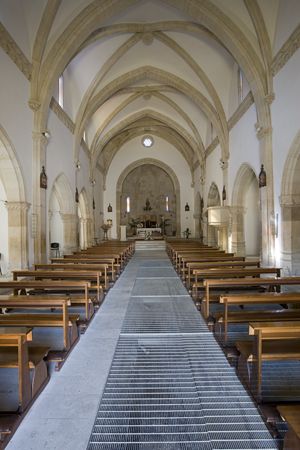
The interior, with a classroom with side chapels, adopts, in the pentagonal presbytery, the model of Saint Francis of Alghero, where adherence to Catalan aesthetics appears to be devoid of local reworkings.
The aisle is divided into five cross-vaulted bays with pointed arches supported by pilasters. The main chapel, the lowest and narrowest of the aisle, has a radial cross with seven segments and a carved gem with Saint Giulia on the cross accompanied by two angels. The pointed triumphal arch is supported by polystyle pillars in a bundle of columns with original capitals in which naked shield-bearing angels alternate with ornate phytomorphs.
The slightly sloping façade, as in the Alghero church, is framed in Santa Giulia by oblique buttresses tapered to polygonal steps at the top, of immediate Catalan origin. A horizontal frame, which follows the buttresses and is underlined by a refined intertwining of inflected arches, reproposed later in almost all the churches of the Meilogu, divides it into two orders. The arches are also present under the crowning, in the terminal part of the nave, in the second order of the bell tower and, inside, above the chapels and in the counterfaçade.
The first order of the prospectus opens in the beautiful elevated-round lily portal adorned with diamond tips and delimited by rampant leaves that, after a slight flexion, give rise to a tall flower flanked by the clients' signs.
Two tall multifaceted pinnacles, born from the capitals, complicate the design of the portal, which is one of the purest examples of Catalan Gothic in Sardinia. In the second order, concluded by an elaborate frame, is a large oculus with a molded ring.
History of studies Previously
studied by Vico Mossa, the church is the subject of a brief fact sheet in the volume by Francesca Segni Pulvirenti and Aldo Sari on late Gothic and Renaissance architecture (1994).
Bibliography
V. Mossa, From Gothic to Baroque in Sardinia, Sassari, 1982;
V. Mossa, Events of Architecture in Sardinia, Sassari, 1994;
F. Segni Pulvirenti - A. Sari, Late Gothic and Renaissance Architecture. Nuoro, Ilisso, 1994, sheet 25.
Content type:
Religious architecture
Province: Sassari
Common: Padria
Macro Territorial Area: Nord Sardegna
POSTAL CODE: 07015
Address: via Nazionale, s.n.c.
Update
Where is it
Padria, Chiesa di Santa Giulia Images number: 3
Images
Video


 Facebook
 Twitter
 LinkedIn
 Whatsapp

 Print
Print
 E-mail


Comments