Subjects





Lying on the south bank of the Tirso river and renowned since ancient times for its thermal waters, the town of Fordongianus is still characterized by the unmistakable color of its homes: the deep red of local volcanite carefully shaped by skilled stonemasons and used in most of the religious buildings and domestic architecture in the area.
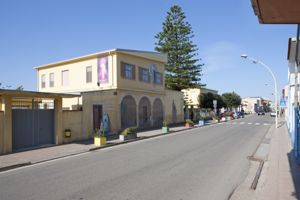
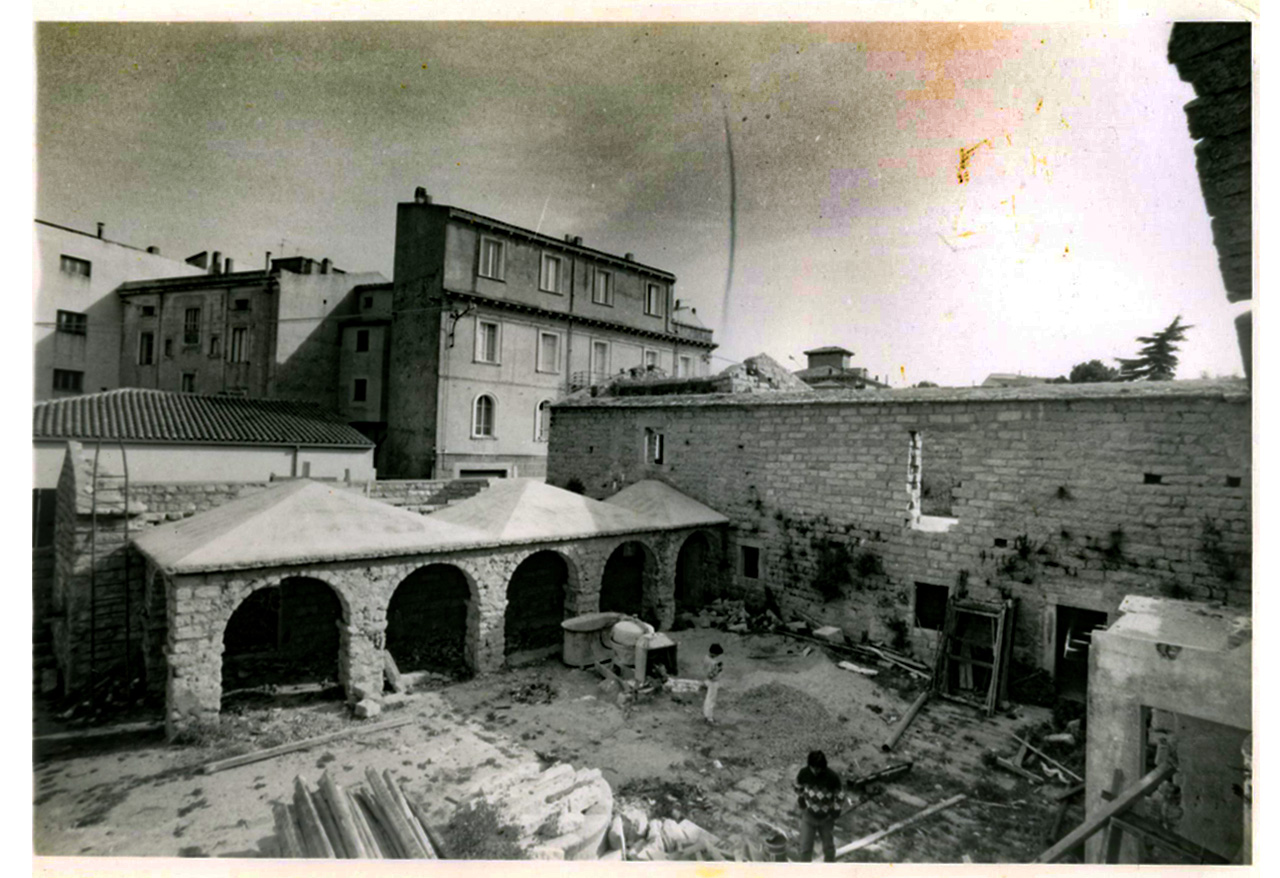
The Aragonese house of Fordongianus was built between the end of the 16th and the beginning of the 17th century. It belongs to the cell type with a loggia and is a rare example of late Gothic Sardinian architecture that has reached us in a good state of preservation. The house, on one floor, extends in length with various rooms side by side and communicating. The front porch, supported by columns with a smooth cylindrical frame and castles shaped in the middle of bulls and gorges, is the result of fairly recent anastylosis and compensation, however in line with other examples in neighboring centers of the Barigadu. A similar porch takes place along the N side of the church of Santa Maria di Ossolo, near Bidonì, and on the S side of the sanctuary of San Basilio in the territory of Nughedu Santa Vittoria, both dating back to the first thirty years of the 17th century. Both inside and in the façade, the elegant red vulcanite frames that surround doors and windows are preserved. Inside, the portals have a characteristic inflected arch while windows and niches have frames decorated with lozenges and diamond tips in relief surmounted by projecting molded and notched shelves according to a taste that is also affected by the Renaissance stylistic features penetrated at the beginning of the seventeenth century through the mediation of religious architecture.
Outside, on the d., the entrance portal with little stones with bulls and shells that turn in the raised eyebrow ring with a shell valve flower is accompanied by an arched window, with a square module, with vertical corners crossed by moldings that intersect with the horizontal ones of the lintriave, marked below by the flame inflection. The same figurative repertoire has the two windows paired in s.: the median is differentiated by the presence on the jambs of a theory of rosettes in relief that crown a medallion with the Christological monogram in the lintel.
History of studies
The house is the subject of a brief summary in the volume by Francesca Segni Pulvirenti and Aldo Sari on late Gothic and Renaissance architecture in Sardinia (1994).
Bibliography
A. Sanna, “Popular Architecture”, in The Sardinian Society in the Spanish Age, edited by F. Manconi, II, Quart, 1993;
F. Segni Pulvirenti - A. Sari, Late Gothic and Renaissance Architecture. Nuoro, Ilisso, 1994, sheet 88.
Structure category: Monument or Monumental Complex
Content type:
Civil architecture
Usability: Open
Province: Oristano
Common: Fordongianus
Macro Territorial Area: Central Sardinia
POSTAL CODE: 09083
Address: via Traiano, 10
Telephone: +39 0783 60157
E-mail: info@forumtraiani.it
Website: www.forumtraiani.it
Facebook: www.facebook.com/ForumTraiani
October - April
Monday - Tuesday - Wednesday - Thursday - Friday - Saturday - Sunday
9:30 AM - 5:30 PM
Maggio - September
Monday - Tuesday - Wednesday - Thursday - Friday - Saturday - Sunday
9:30 AM - 7:30 PM
Information on tickets and access: It is advisable to check for any changes in hours by contacting Soc. Coop. Forum Traiani at +39 0783 60157 before the visit.
Access mode: For a fee
Tickets :
Services information: Multilingual audio guides are available in French, English, German, Spanish. The educational workshops (upon reservation) are aimed at students of: kindergarten, primary and first grade secondary school. The educational tour can be carried out both in the morning and in the afternoon, it is also possible to include lunch.
Other services: Specific visit itinerary for children.
Update
Services
 Teaching room
 Audiooguide
 Guided tours
Where is it
Texts

Author : Siotto Ferrari, Larissa
Year : 1885
Author : Lamarque, Vivian
Results 2 of 1426795
View All


 Facebook
 Twitter
 LinkedIn
 Whatsapp

 Print
Print
 E-mail
Comments