Subjects





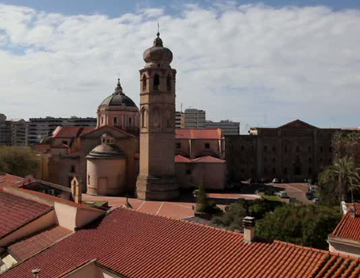
The center of Villamar is located on a terrace in the lower Marmilla, in south-central Sardinia. In the area, frequented by the Neolithic period, there are testimonies from the Nuragic and Punic periods. The parish church of San Giovanni Battista, a short distance from the Romanesque church of San Pietro, overlooks a large square.
The “villa” of Mara Arbarei, now Villamar, belonged to the court of Arborea and was dependent on the curatorship of Marmilla, of which it was the capital, and on the diocese of Usellus (or Ales). It is mentioned for the first time in a document dated October 29, 1206, which we know from the transcription, made in the 16th century, of a copy of 1307, concerning the agreement signed between Guglielmo I-Salusio IV de Lacon Massa, judge of Cagliari, and Ugone I de Bas-Serra, judge of Arborea, to clarify the delimitation of the boundaries between the two judges. Mara Arbarei moved to Cagliari, but returned to the Arborea in 1258, following the fall of the Cagliari court. On 20 July 1219, it was donated, together with other villas, by the Cagliari judge Lamberto Visconti to his son Ubaldo, on the occasion of his marriage to Adelasia de Lacon-Gunale. The toponym Mara was combined with the geographical attributes of Arbarei or Arbaressa, to indicate the belonging of the villa to the court of Arborea.
In the rectangular façade of the church, facing N/O and plastered, the remains of the Romanesque structure are evident, attributable to the second half of the 13th century, a period to which the nearby church of San Pietro is also attributed. The large portion of the Romanesque wall wall is made of medium-sized limestone and vulcanite ashlar. A padded portal opens up with a monolithic lunette and lintel resting on capitals. These, cut flush in the faces of the jambs, are sculpted, in the faces faced, with a pair of leaves with an inverted and flattened top. In some ashlars of the semicircular drain arc, there are four hemispherical recesses, one of which is larger, which should have housed as many tiled walls that have now been lost.
In the 16th century, the building was rebuilt in late Gothic forms, according to the Sardinian-Catalan prototype reworked in the parish church of San Giacomo di Villanova in Cagliari, which was a model for many churches in southern Sardinia. The floor plan has three naves, with side chapels added at different times, some of which show Gothic vaults. The church has been restored since the 19th century. Two chapels remain from the 16th century construction phase. In the center of the main façade, the portal opens, framed by a molded frame. In line with this is a window, flanked by two smaller ones. The façade houses two other entrances. On the end plate there are two decorative elements with a spiral pattern. The presbyterial compartment, smaller and lower than the nave, with a square plan and a starry vault dotted with hanging gems at the keys to the arch, is similar to that of Saint James in Cagliari. There are buildings attached to the apsidal part of the building. The dome of the chapel that adjoins the presbytery is visible.
Aligned to the left of the main façade is the square-barreled bell tower, which is based on a high plinth and has a flat end. The clocks top the four single-light windows, one open on each side. Even the bell tower, dating back to the 16th century renovation, refers to the Cagliari prototype. The decorations take up, although in much simpler forms, those in the terminals of 17th century Spanish plateresque architecture.
History of studies
The church, reported by Vittorio Angius, is published in Roberto Coroneo's volume on Romanesque architecture and in the works on Marmilla.
Bibliography
V. Angius, entry “Mara Arborei”, in G. Casalis, Historical, Statistical and Commercial Geographical Dictionary of the States of His Majesty the King of Sardinia, X, Turin, G. Maspero, 1842; The Province of Cagliari. The municipalities, edited by N. Sciannameo-F. Sardi, Cinisello Balsamo, Silvana, 1985 (2nd ed.);
R. Coroneo, Romanesque architecture from the middle of the thousand to the early '300, Nuoro, Ilisso, 1993, sheet 135;
G. Murgia, “From the collapse of the Arborean court to the Aragonese-Spanish rule”, in Villamar. A community, its history, Dolianova, Grafica del Parteolla, 1993;
A. Ingegno, History of the restoration of monuments in Sardinia from 1892 to 1953, Oristano, S'Alvure, 1993; Inside the Marmilla. Environment, History, Culture, Lunamatrona, Sa Corona Arrubia, 2000;
R. Coroneo, Romanesque Churches of Sardinia. Tourist-cultural itineraries, Cagliari, AV, 2005, p. 82.
How to get there
Once you take the SS 131 from Cagliari, after traveling about 40 km, turn around and take the SS 197, which leads, after less than 10 km, to Villamar, where the church of San Giovanni Battista is located.
Content type:
Religious architecture
Province: South Sardinia
Common: Villamar
Macro Territorial Area: South Sardinia
POSTAL CODE: 09020
Address: piazza Carlo de Corte, s.n.c.
Update
Where is it
Video


 Facebook
 Twitter
 LinkedIn
 Whatsapp

 Print
Print
 E-mail
![[S. Pasquale : statua del Lonis sita nella Chiesa di San Mauro a Cagliari]](data:image/png;base64,iVBORw0KGgoAAAANSUhEUgAAAAEAAAABCAQAAAC1HAwCAAAAC0lEQVR42mNkYAAAAAYAAjCB0C8AAAAASUVORK5CYII=)

Comments