Subjects





The territory of Selargius has been intensely inhabited since prehistoric times. The church of San Giuliano, perhaps the town's ancient parish church, is now used as an oratory by the brotherhood of Our Lady of the Rosary. As part of the restoration, carried out at the end of the eighties of the last century, archaeological traces from prehistoric to post-medieval times have been identified. A series of burials has returned grave goods from the XII-XIII centuries and, among other things, also a plumbeous sign of Romeo pilgrimage.
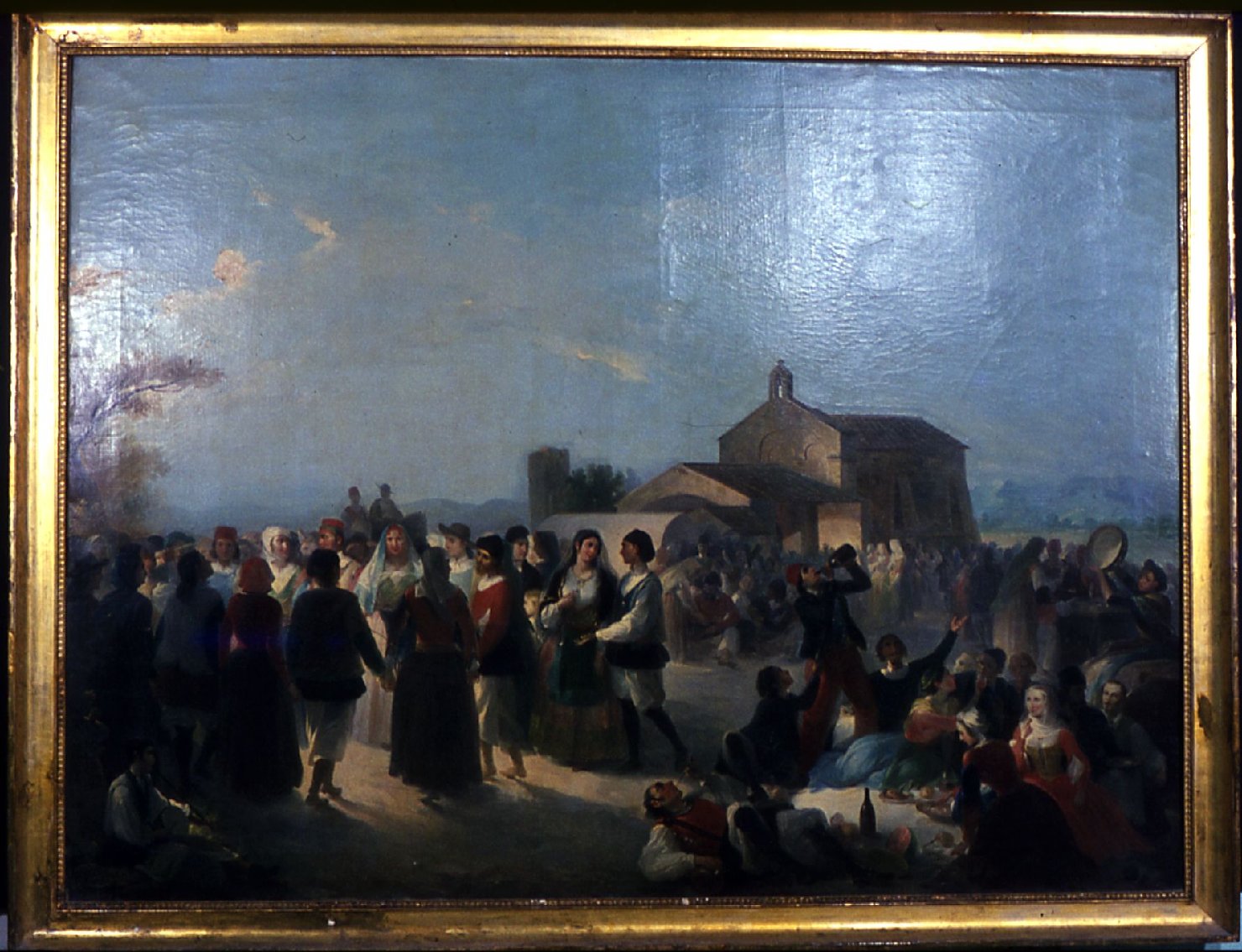
The church of San Giuliano is famous for the setting, inside, of the suggestive “Selargino wedding”, which makes use of the archaic and at the same time traditional charm emanating from its Romanesque forms.
There is no documentary information on the structure of the church, which presumably dates back to the 12th century. In the next one, it was remodeled, with the reconstruction of the apse. The façade is preceded by a five-seventeenth-century porch.
The classroom is carved, with wooden truss roof in the central aisle, pitched in the side aisles. The three naves are divided by arches on stocky limestone bare columns. The capitals are for reuse.
In the center of the façade, the portal opens, arched with an eyebrow bezel set on zoomorphic floors. In both pediments there is a mullioned window.
The apse is punctuated in mirrors by belted pilasters, with a single light. A series of arches crowns the terminal, as well as those of the median aisle.
History of studies
For the church of San Giuliano, you can consult the entry “Selargius” (1949) by Vittorio Angius, in the “Dictionary” of Casalis, followed by the study of Dionigi Scano (1907). Much later is the article by Giuseppe Nieddu (1987), dedicated to Roman capitals reused in the classroom. In 1989, an article by Paolo Serra, Renata Serra and Roberto Coroneo was published, giving an account of the results of archaeological excavations in the area and inside the church. On the latter in particular, you can read the fact sheets in the volume by Renata Serra (1989) and Roberto Coroneo (1993) on Romanesque architecture in Sardinia.
Bibliography
V. Angius, “Selargius”, in G. Casalis Historical and Statistical-Commercial Geographical Dictionary of the States of His Excellency the King of Sardinia, XVIII, Turin, G. Maspero, 1849, p. 796;
D. Scano, History of Art in Sardinia from the 11th to the 14th century, Cagliari-Sassari, Montorsi, 1907, p. 332;
G. Nieddu, “The Roman capitals of the Church of S. Giuliano in Selargius”, in Notebooks of the Archaeological Superintendence for the Provinces of Cagliari and Oristano IV,, 1987, part II, pp. 43-50; A. Pasolini-G. Stefani-E. Strati, The Church of San Giuliano in Selargius. XIII century, Cagliari, 1988;
P.B. Serra-R. Crown-R. Serra, “S. Giuliano di Selargius (Cagliari)”, in Notebooks of the Archaeological Superintendence for the Provinces of Cagliari and Oristano, 6, 1989, pp. 227-259;
R. Serra, Sardinia, series “Romanesque Italy”, Milan, Jaca Book, 1989, pp. 345-346;
A. Sari, “Stone Jewel”, in Sardinia Exhibition, 1991, without pages; R. Coroneo, Romanesque architecture from the middle of the thousand to the early '300, Nuoro, Ilisso, 1993, sheet 72; R. Coroneo, Romanesque architecture from the middle of the thousand to the early 1900s, Nuoro, Ilisso, 1993, sheet 72;
R. Coroneo, Romanesque architecture from the middle of the thousand to the early 1900s O-R. Serra, Pre-Romanesque and Romanesque Sardinia, series “Italian artistic heritage”, Milan, Jaca Book, 2004, pp. 260-261; R. Coroneo, Romanesque Churches of Sardinia.
Tourist-cultural itineraries, Cagliari, AV, 2005, p. 95.
Content type:
Religious architecture
Province: Cagliari
Common: Selargius
Macro Territorial Area: South Sardinia
POSTAL CODE: 09047
Address: via San Niccolò, s.n.c.
Website: https://www.comune.selargius.ca.it
Update
Where is it
Selargius, Chiesa di San Giuliano Images number: 1
Video

Year : 1997
Year : 1997
Results 2 of 37430
View All


 Facebook
 Twitter
 LinkedIn
 Whatsapp

 Print
Print
 E-mail
Comments