Subjects





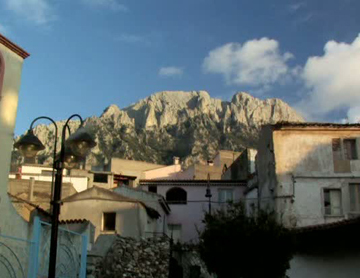
The site is located about 300 m above sea level in the municipality of Oliena, within the Lanaitto Valley, immersed in dense vegetation, on the foothills of Mount Uddé, in a limestone area of the Supramonte.
The Nuragic village known as Sa Sedda and Sos Carros (literally “the crossing point of the wagons”) is located in a phase between the Recent Bronze and the Early Iron Age (sec. XII-IX BC). It looks like an extensive village of huts in the upper part of which there is a unique structure that makes this site, already highly suggestive due to its geographical location, immersed in the wild and unspoiled nature of the Supramonte di Oliena, one of the best known in Sardinia in its type.
The site is part of the complex and heterogeneous framework of attestations of architectures with a sacral value linked, in some way, to the cult of water in Sardinia in the Nuragic Age: these areas consisted of one or more buildings functional to the collection and channeling of water, as well as various service environments; the complex then became, over time, the new catalyst for the residential settlement.
Nuragic sanctuary villages are often characterized both by the presence of the most famous “well temples”, and by the so-called “roundabouts” or “roundabouts with bacilli”, i.e. smaller circular buildings, which are built according to a standardized architectural module, widespread in the Sardinian territory (Sa Mandra 'e sa Giua di Ossi, S'arcu 'e is Forros di Villagrande Strisaili, Sant'Imbenia di Alghero, Sirai in Carbonia, San Luca di Ozieri, Santa Barbara di Bauladu, Pidighi by Solarussa, Seleni di Lanusei, Carcaniedda di Sedini, Sa Sedda de Sos Carros di Oliena), characterized by a perimeter seat that runs along the wall and a lithic basin in the center of the room: the room of Sa Sedda de Sos Carros, perhaps the best-known example of a roundabout, re-proposes the consolidated architectural model in monumental forms and perfectly isodome.
In its complexity, the Sa Sedda de Sos Carros site is characterized by circular and oval huts, as well as a building/insula with a sub-circular outer perimeter within which quadrangular and circular rooms, with a varied function (worship spaces, buildings for the storage/storage of metal products, workshops) are arranged radially around the central courtyard, also with a circular plan in which the tub is contained. The insula is separated from the rest of the village by a cyclopean outer wall.
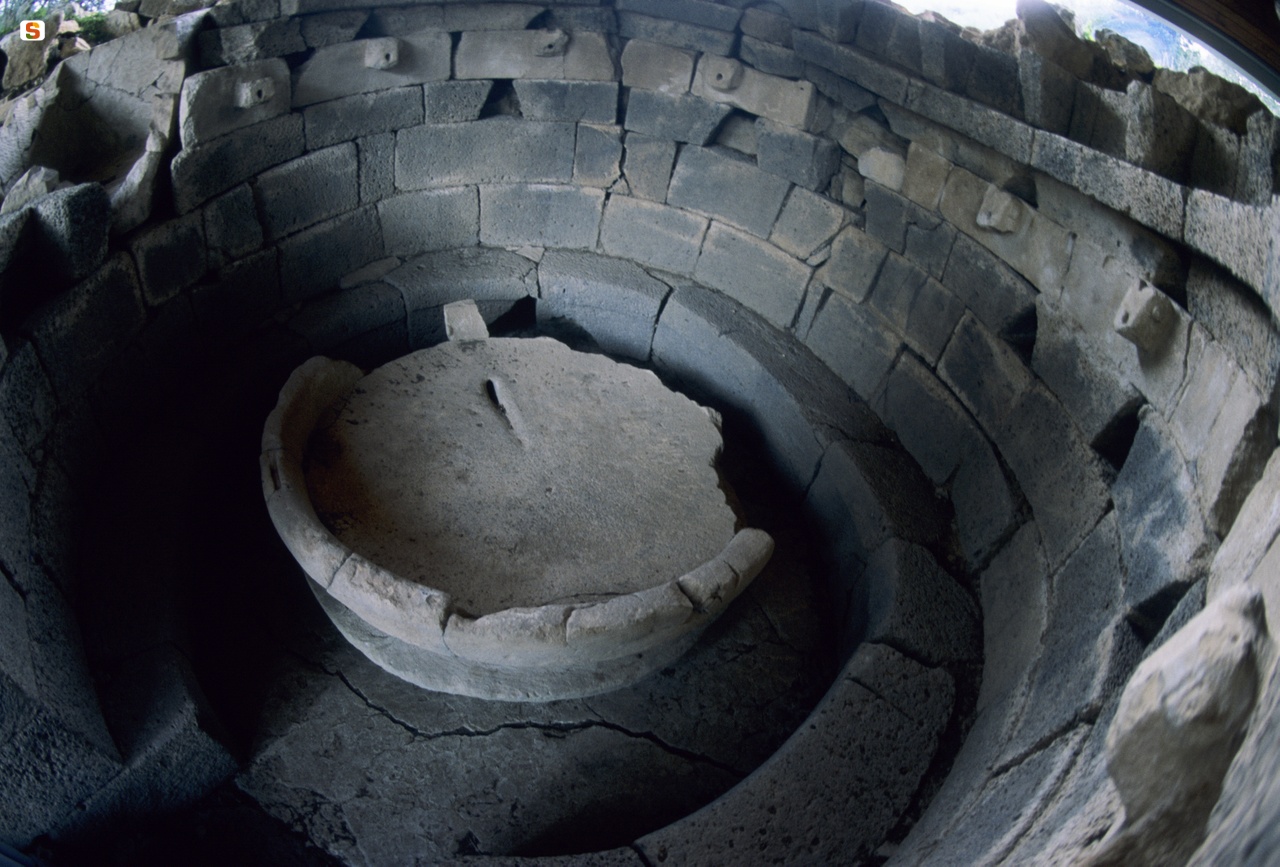
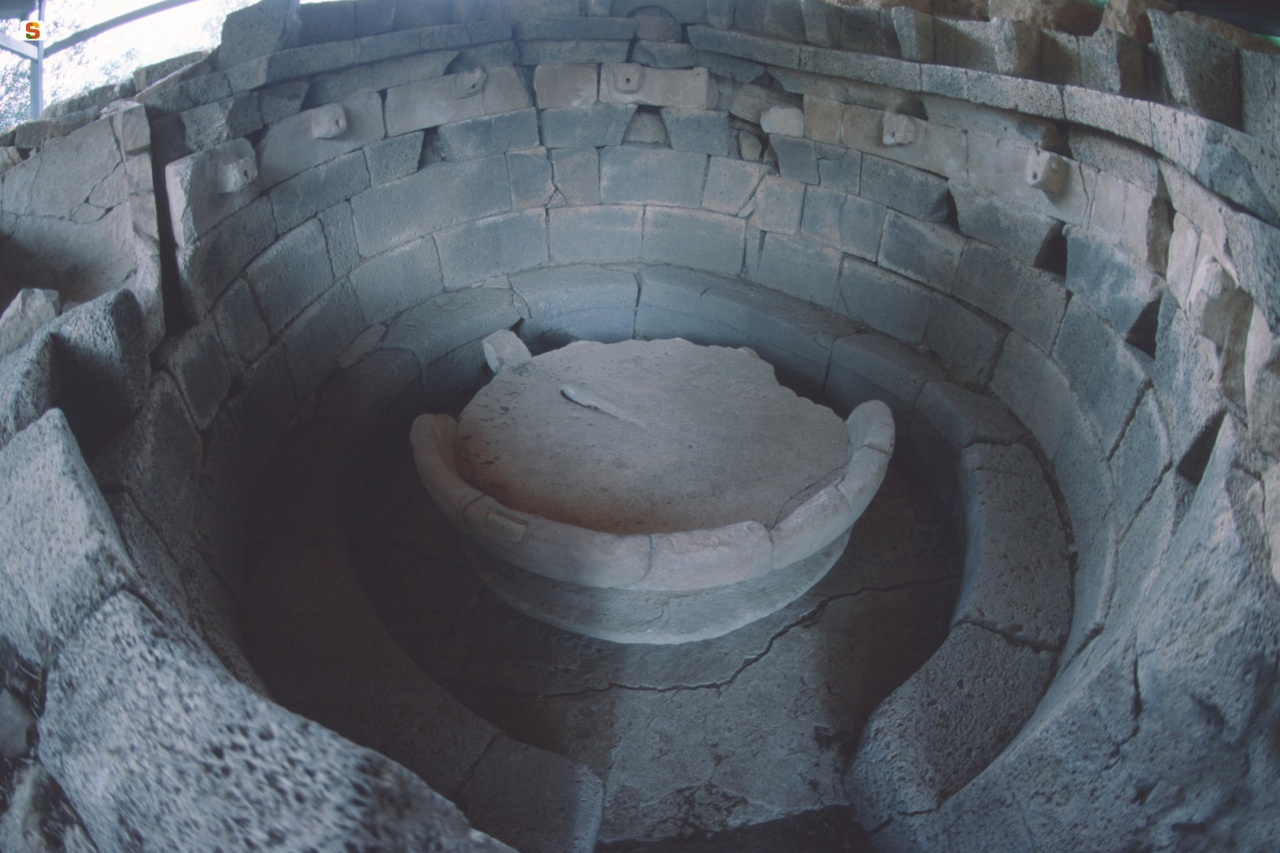
The so-called rotunda with a basin, here served probably as a sacral function, appears as a circular environment with a diameter of 2.5 m and with a maximum elevation of 1.80 m. Also referred to as a “source”, its internal walls have a two-tone chromatic effect because they are made in isodome work with square blocks of white limestone that alternate with rows of dark basalt blocks; the floor, consisting of a natural limestone top, has been carefully worked. The entrance to the room still has part of the jambs and is delimited by a basalt threshold consisting of a light relief strip. Along the inner circumference runs a seat made of basalt stones that have a slight molding to dampen the edges. At the center of the compartment is the large basin (with a diameter of about 70 cm), obtained from the processing of a monolithic sandstone block, with a powerful ring foot and a hole for the passage of water. Seven (originally nine) mouflon and/or ram heads are carved in high relief on the walls of the circular environment, which have a hole through which the water, which came from the channel created in the thick wall, could flow into the monolithic circular basin located in the center of the floor. The fundamental element of this architecture is water, the use of which was implemented with extraordinary hydraulic expertise for the time when the cultural structure was built, embellished by the sophisticated decoration of the mouflon-headed drippers. Furthermore, its location, located in a place above the underlying village, accentuating its monumentality, suggests even more its religious-sacral value.
Outside the cyclopean wall containing the main insula, a second roundabout smaller than the main one has been identified: it seems to have been dismantled in ancient times and then included inside a more recent rectangular room and turns out to be decidedly less sumptuous. The sanctuary of Sa Sedda de Sos Carros, in addition to its cultural value, is of particular importance as a center for the fusion and processing of metals: within the sacred area, a large number of metal objects have been found, mainly of bronze, numerous even in a highly flawed state, perhaps because they were destined for a new processing cycle, such as fragments of axes, spears and arrows, piccones, bacilli lugs, fibulae, bands of handles pertaining to tools of various types, pins (of which some with elaborate heads), panels, as well as objects of particular value such as ships of various types and a double-necked askoid jug (including a spout with an expanded trumpet rim and a second neck, at the opposite end, configured as a taurine protome surmounted by large horns).
History of excavations and studies
The archaeological site has been the subject of numerous excavation campaigns since the Seventies of the last century: the first investigations were conducted by Fulvia Lo Schiavo who highlighted an impressive structure consisting of a series of circular rooms that open onto a large courtyard crossed by a channel for collecting rainwater and a staircase of local limestone slabs that connects the complex with the environments above. In 1993, a new investigation campaign became necessary following clandestine excavations: the intervention was carried out by M.A. Fadda, made urgent in some places where the masonry and the surface archaeological layer had been damaged. Between 2001 and 2007, repeated excavation campaigns were carried out that highlighted the village huts.
Bibliography
G. Salis, Wells, Sacred and Round Sources, in A. Moravetti, P. Melis, L. Foddai, E. Alba (edited by), Nuragic Sardinia. History and monuments, series “Corpora delle Antiquità della Sardegna”, Sassari 2017, pp. 253-276.
G. Salis, Sa Sedda 'e sos Carros di Oliena, in M. E. Minoja, G. Salis G., L. Usai (edited by), The Island of Towers. Giovanni Lilliu and Nuragic Sardinia, Exhibition Catalogue (Cagliari, 15 March-30 September 2014, Rome, 28 November 2014-7 April 2015, Milan, 6 May 2015-14 February 2016), Sassari 2015, pp. 296-301.
G. Salis, The roundabouts with bacilli: a new contribution from the Nuragic village of Sa Sedda 'e Sos Carros-Oliena, “FOLD&R”, 2013 pp. 1-10,
M.A. Fadda, G. Salis, Sa Sedda 'e sos Carros and the Lanaitho Valley (Oliena), series “Archaeological Sardinia. Guides and Itineraries”, 46, Sassari 2010.
M.A. Fadda, The complex of Sa Sedda 'e sos Carros di Oliena. The new discoveries (2002-2008). A unique example of religious architecture from the Nuragic period, in M. A. Fadda (edited by), A Mountain Community for the Valorization of the Archaeological Heritage of Nuoro, Cagliari 2008, pp. 133-146.
G. Salis, The island of Sa Sedda 'e sos Carros (Oliena): the 2006-2007 campaign and the new materials, in M.A. Fadda (edited by), A Mountain Community for the Valorization of the Archaeological Heritage of Nuoro, Cagliari 2008, pp. 147-189.
M.A. Fadda, Oliena (Nuoro). The Nuragic complex Sa Sedd'e sos Carros in Oliena. The new discoveries. Reflections on the religious architecture of the Nuragic period, in “SCeba - Sardinia, Corsica et Baleares Antiquae. International Journal of Archaeology”, IV, 2007 pp. 77-88.
G. Salis, New excavations in the villages of Sa Sedda 'e sos Carros Oliena (Nuoro), in “SCeba - Sardinia, Corsica et Baleares Antiquae. International Journal of Archaeology”, IV, 2007 pp. 78-89.
M.A. Fadda, Sa Sedda and Sos Carros (Oliena). The Nuragic Village, in “Bulletin of Archaeology”, 1993, 19-21, pp. 170-172.
How to get there
From the Oliena exit E, on the Via Ingegner Marco Gallani road, take SP 46 and proceed to the fork for the Su Gologone Source, on the right if you are coming from Oliena, which will be marked by a road sign. Continue on the Su Gologone road, which is part of the difficult Lanaitto dirt road, following the signs for the Sa Oche cave, and stop the car. Sa Sedda e Sos Carros is located, above a steep ridge, on the O side of the valley.
Structure category: archaeological area or park
Content type:
Archaeological complex
Archaeology
Usability: Open
Province: Nuoro
Common: Oliena
Macro Territorial Area: Central Sardinia
POSTAL CODE: 08025
Address: SP 46 Oliena-Dorgali - località Valle del Lanaitto, "Rifugio Sa Oche"
Telephone: +39 347 8249517
E-mail: info@sardiniainside.it
January - December
Monday - Tuesday - Wednesday - Thursday - Friday - Saturday - Sunday
9:00 AM - 6:00 PM
Access mode: For a fee
Tickets :
Services information: Guided tours are available for the Sa Sedda Nuragic Village and Sos Carros and the Corbeddu Cave.
Other services: About 1.5 km away, before the ticket office, there is a refreshment point where rooms are available.
Update
Services
 Guided tours
Where is it
Video


 Facebook
 Twitter
 LinkedIn
 Whatsapp

 Print
Print
 E-mail


Comments