Subjects





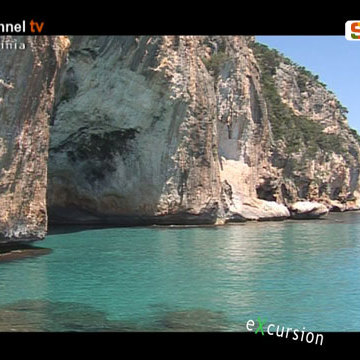
The Bue Marino cave opens directly to the sea, in the spectacular limestone cliffs of the Gulf of Orosei. It consists of two large tunnels that have a total length of 4 km.
About twenty anthropomorphic figures have been identified, a cup and two circles with a small central cup; the motifs are mostly grouped together. A small group of three figures is engraved about 2 m a s., an isolated figure is located 2.5 m away, at the top.
The figures are of the “double-fork” type, with a vertical segment (the body) and two opposing semicircles (the arms raised and the legs bent). The vertical segment is an average of 30 cm long. The incision groove is 1 cm.
The pattern has numerous variations: an isolated “candlestick” figure, with multiple limbs; two figures with an oblique lateral appendix; a figure with legs and arms bent in the same direction. The limbs are more or less long, inclined and arched. The figures appear erect and are arranged with great freedom between them and with respect to the three circular motifs.
The interpretation of the scene is problematic. Scholars suppose that it is a dance that involves exclusively men (the lower part of the vertical segment would represent the male sex). The cup and the circles with the cup would be connected with a solar symbology.
As far as dating is concerned, there are no decisive elements. Comparisons with a figurine of the Frattale shelter (Oliena), with the “inverted anchoriform” motif of the Sardinian statues-menhirs, and with motifs of Camunian art, lead to placing the figurations on the horizon of the final Eneolithic (2100-1800 BC).
History of the excavations
The figurations are engraved at the entrance of the cave, in the curved surface of the rock, just before the passage to the Room of the Blonde Lady, where in the forties of the twentieth century a brief excavation was carried out by Giovanni Lilliu. The excavation returned materials from the culture of Saint Michael (Final Neolithic, 3200-2800 BC).
The discovery of figurations, in 1977, aroused great interest because for the first time on the island, prehistoric engravings were found in a cave for which a non-sepulchral use could be assumed.
Their reading is made difficult by the irregularities of the limestone and by the state of corrosion caused by salt on the surfaces of the cave.
Bibliography
F. Lo Schiavo, “The Sea Ox Cave in Cala Gonone”, in Dorgali, archaeological documents, Sassari, Chiarella, 1980, pp. 39-45;
F. Lo Schiavo, “Dorgali (Nuoro) .Loc.Cala Gonone”, in I Sardi. Sardinia from the Paleolithic to the Roman Age, edited by E. Anati, Milan, Jaca Book, 1984, pp. 195-197.
How to get there
The cave can be reached by sea with ferries that dock in the small port of Cala Gonone.
Content type:
Archaeology
Usability: unmanaged site
Province: Nuoro
Common: Dorgali
Macro Territorial Area: South Sardinia
POSTAL CODE: 08022
Address: Costa del Bue Marino - località Cala Gonone
Information on tickets and access: It is possible to visit the Grotta del Bue Marino by sea, especially during the summer period, using small ferries that leave from the small port of Cala Gonone. The number of visitors is limited.
Update
Where is it
Images

Year : 1905
Year : 1905
Results 2 of 122297
View All
Video


 Facebook
 Twitter
 LinkedIn
 Whatsapp

 Print
Print
 E-mail
Comments