Subjects





The tombs are dug along the northwestern ridge of the small trachytic plateau of Tungòri-Corte 'e Jana, in Barigadu, a region of central Sardinia.
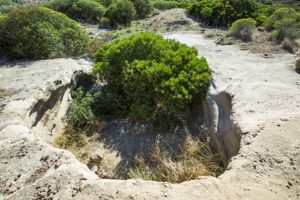
The necropolis includes 24 domus de janas; two of them, tombs XVIII and XIX, are heavily remodeled. Pedaroles and steps dug into the rock wall facilitate access to burials. The entrances to the hypogeans, facing S/SE, located at different heights from the country level and on overlapping floors, are generally preceded by a short access pavilion or, more rarely, by a “dromos”. The entrance wall of Tomb V has - above the hatch - a groove at an acute angle, perhaps the representation of the slopes of a double-sloped roof. The caves are mainly multicellular, even if the number of rooms is not very high. The planimetric pattern, detectable only in part in some hypogeums due to the poor state of conservation, is almost always of a longitudinal projection, with an entrance pavilion, anticella and main cell enriched, sometimes, by one or more lateral extensions. The cells have circular, sub-circular, rectangular, trapezoidal planes and vertical or slightly concave walls. The ceilings are generally flat and more rarely concave. In the anticles of tombs II, V, VII, XX, XXI, a single-sloped roof is reproduced. The hatches, many of which are damaged by natural processes and, above all, by human work, are generally rectangular and trapezoidal in shape. They are often framed (especially the internal entrance doors) by means of relief frames. Funerary beds can be seen in tombs VII, VIII, XIV, XVIII, XX. Seven dividers, generally arranged in the main cell, are present, on the other hand, in domus XIV, XVIII, XX.
In other tombs (III, IV, VI, XV, XX) small niches appear for offerings. There are also votive dimples, mainly dug into the floor of the anticell (tombs V, VI, XIV, XIX). Traces of red paint, a symbol of blood and regeneration, are present in tombs II, X, XIII, XV, XVI, VI, VIII. Among all the domus, Tomb IX stands out, which has - inside the main chamber - the reproduction of a “false door” associated with bullfighting horns; on the sides there are two squares obtained through a slight engraving. Just below the ceiling line there is a rectangular band that seems to interrupt at the false door. In Tomb XII, inside the main cell, in the middle part of the back wall, a series of small equilateral triangles, rendered with red paint, come together to form a horizontal band. The necropolis dates back to the late Neolithic (culture of Ozieri, 3200-2800 BC) and to the Eneolithic.
History of excavations
The necropolis has been studied starting from the last decades of the last century.
Bibliography
A.M. Cossu, “The Necropolis of Campu Maiore, Busachi (Oristano)”, in The Culture of Ozieri. Sardinia and the Mediterranean in the 4th and 3rd Millenium BC, Proceedings of the Second Study Conference (Ozieri 15-17 October 1990), edited by L. Campus, Ozieri, Il Torchietto, 1997, pp. 307-313, figg. 1-3;
G. Bacco, “The Hypogeic Necropolis of Campumajore - Busachi (OR)”, in Proceedings of the International Congress Hypogeism in the Mediterranean: Origins, Development, Cultural Frameworks (Sassari-Oristano, 23-28 May 1994), II, Muros, Stampacolor, 2000, pp. 971-978, figs. 1-4.
How to get there
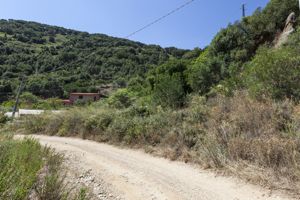
Busachi can be reached from Oristano by taking the SS 388 for about 23 kilometers. The hypogeic necropolis of Campu Maiore is located on the edge of the homonymous southern district of the modern town of Busachi. Almost all the tombs are accessible through the courtyards behind the numerous houses placed in a row along Largo Cavour.
Content type:
Archaeological complex
Archaeology
Usability: unmanaged site
Province: Oristano
Common: Busachi
Macro Territorial Area: Central Sardinia
POSTAL CODE: 09082
Address: località Campu Maiore
Website: www.comune.busachi.or.it/index.php/vivere/cultura/29
Update
Where is it
Images
Audio

Author : Falgio Walter
Results 2 of 12993
View All


 Facebook
 Twitter
 LinkedIn
 Whatsapp

 Print
Print
 E-mail
Comments