Subjects





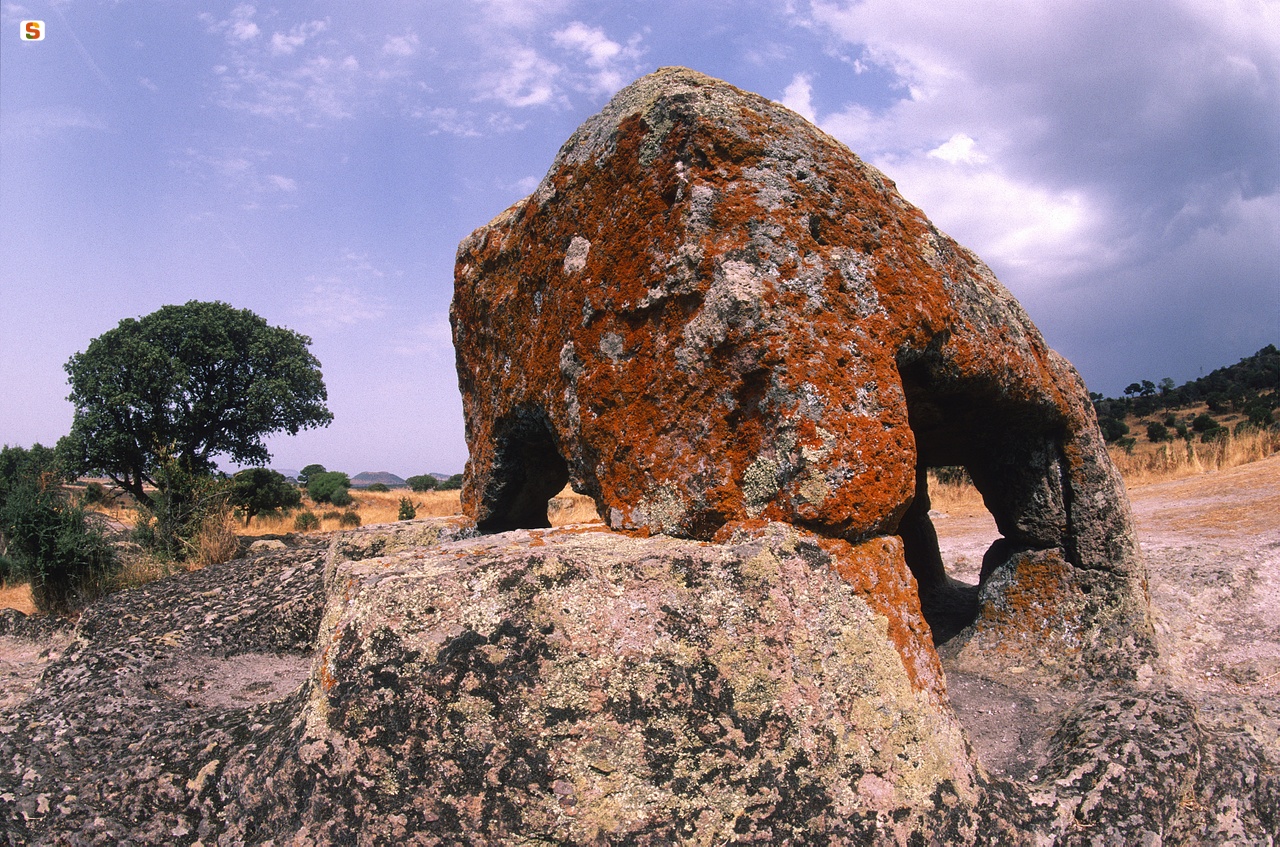
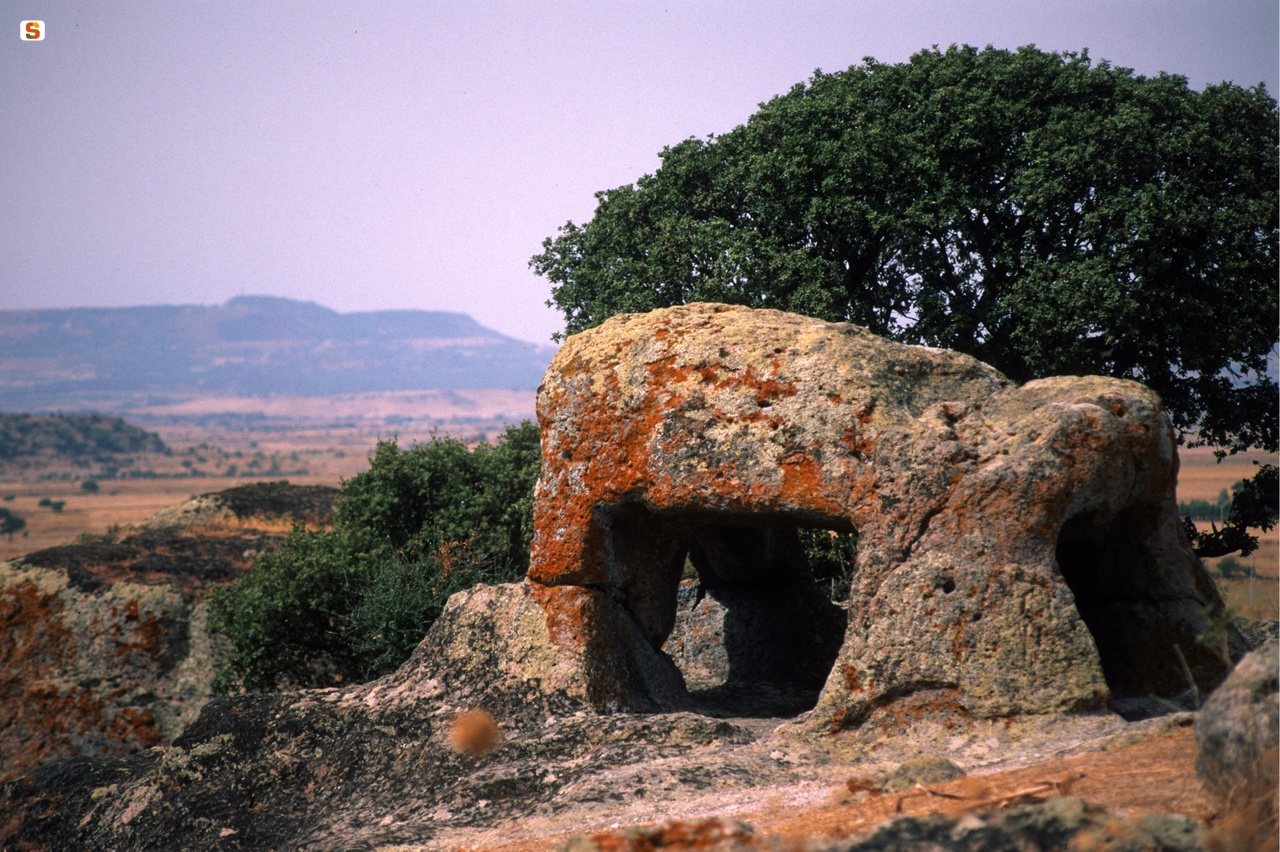
In the necropolis of Sant'Andrea Priu, consisting of about twenty underground tombs, only one domus de janas - tomb VI, also known as Tomb of the Head - has been reused for Christian worship, in two chronologically distinct moments, until it came to us as a church dedicated to Saint Andrew.
The tomb consists of eighteen rooms, of which the three largest are aligned along the longitudinal axis. The intermediate cell preserves fragments of Christian frescoes on the wall where the passage to the innermost room opens: at the top, inside a box delimited by a red band, festoons and little birds are painted, while on the left a female figure looks at the spectator and at the same time addresses the cross depicted above the passage to the inner chamber. The walls of the latter depict, from the left, some scenes from Jesus' childhood accompanied by images of the divine blessing hand, peacocks and the announcement to the shepherds. In the center, in line with the entrance, is the figure of the Blessing Christ. The figures of five saints, identified as apostles by their names, occupy the right walls, followed by Saint John the Baptist, the Virgin Mary and five other apostles or saints.
Under the fresco of the Blessing Christ, another pictorial layer has been identified with the same technical-formal characteristics as the paintings in the middle room, pertaining to an early Christian use of the prehistoric hypogeum. After this moment, for which it is not possible to clarify whether it was a funerary or cultural use, the transformation into a church arrived, documentable thanks to the iconography of the frescoes in the innermost room. The room closest to the entrance served as a narthex, intended to accommodate those who had not yet received baptism, the central one was reused as a room for the faithful who, on the other hand, had already received the sacrament of baptism, and the next room as a presbytery, a space reserved for priests.
The frescoes in the middle chamber are dated by scholars to between the 4th and 6th centuries. In the innermost room, however, the frescoes can be dated, even with some doubts, to the second half of the 8th century. The two burials excavated in the narthex floor have been traced back to Byzantine times.
History of the excavations
Although the archaeological area was known to historians as early as the 16th century, it was only in 1916 that a real excavation campaign was organized, conducted by Antonio Taramelli, who carried out accurate surveys. The restoration of the monument was carried out in the late nineties of the last century.
Bibliography
G. Spano, "Catacombe di Sant'Andrea Abriu presso Bonorva", in Bulletino Archeologico Sardo, II, pp. 170-179;
A. Taramelli, Fortezze, recinti, fonti sacre e necropoli preromane nell'agro di Bonorva, collana "Monumenti antichi dei Lincei", Roma, 1919, coll. 765-904;
R. Caprara, La necropoli di Sant'Andrea Priu, collana "Sardegna Archeologica. Guide ed itinerari", Sassari Carlo Delfino, 1986, pp. 3-73;
A. Saiu Deidda, "Il corredo iconografico nell'architettura rupestre della Sardegna. Le pitture di Sant'Andrea Priu", in Atti del seminario di studio: il popolamento rupestre dell'area mediterranea. La tipologia delle fonti, gli insediamenti rupestri della Sardegna", Lecce, 1988, pp. 279-291;
A.M. Nieddu, "La pittura paleocristiana in Sardegna: nuove acquisizioni", in Rivista di Archeologia Cristiana, LXXII, 1996, pp. 245-283;
La necropoli di Sant'Andrea Priu, a cura di A. Boninu-M. Solinas, Macomer, 2000;
R. Coroneo, "Gli affreschi di Sant'Andrea Priu a Bonorva. Nota preliminare", in Archivio Storico Sardo, XLIII, 2003, pp. 9-38;
R. Coroneo-R. Serra, Sardegna preromanica e romanica, collana "Patrimonio artistico italiano", Milano, Jaca Book, 2004, pp. 61-68;
R. Coroneo, Chiese romaniche della Sardegna. Itinerari turistico-culturali, Cagliari, AV, 2005, pp. 55-56.
How to get
From the town of Bonorva, take the road to Bono and follow it for about 6 km, then turn right onto a paved road that leads to the country church of Santa Lucia. Go past it and continue for another 500 meters until you reach, on the left of the road, the fenced area of the necropolis.
Content type:
Archaeological complex
Archaeology
Province: Sassari
Common: Bonorva
Macro Territorial Area: Nord Sardegna
POSTAL CODE: 07012
Address: SP 43 - 07012 Bonorva - località Santa Lucia
Telephone: +39 348 5642611
E-mail: santandreapriu@libero.it
Website: santandreapriu.mystrikingly.com
Information on tickets and access: In order to see the frescoes of Sant'Andrea Priu, it is necessary to contact the manager of the area of the Necropolis of Sant'Andrea Priu. Go to the website. In the winter months from November to February, the necropolis is open by reservation only by contacting the number +39 3485642611 well in advance, or by writing to the email santandreapriu@libero.it
Update
Where is it
Video


 Facebook
 Twitter
 LinkedIn
 Whatsapp

 Print
Print
 E-mail



Comments