Subjects





'Plaça del Bisbe' means 'Bishop's Square', because right on the square that houses the theater stands the bishop's palace, still today the seat of the Curia.
The Civic Theater of Alghero, completed in 1862, is today the only one in Sardinia to preserve the supporting structure made of wood. It was built with the contribution of all the citizens (before the old wheat warehouses were built on the site). The façade is neoclassical in taste, harmonically rhythmic by six ionic semipillars.
In 1842, a public competition was launched for the construction of the new structure, the previous theater being nothing more than a modest and inadequate room granted by King Vittorio Emanuele I and managed by the Society of Theater Amateurs. The architect Felice Orsolini's project won, which was later discarded, because it involved too onerous execution costs. The task for drafting a new project was entrusted to the architect Franco Poggi. The work lasted four years, from 1858 to 1862. The façade and sides of the building were left unplastered, causing quite a bit of discontent among the people. The building responds to a classicism in a way that fits well into the urban context of the city, it also suggests the lack of plaster on the external façades, which, although not wanted, unites it with the buildings with a Catalan imprint with an exposed wall wall.
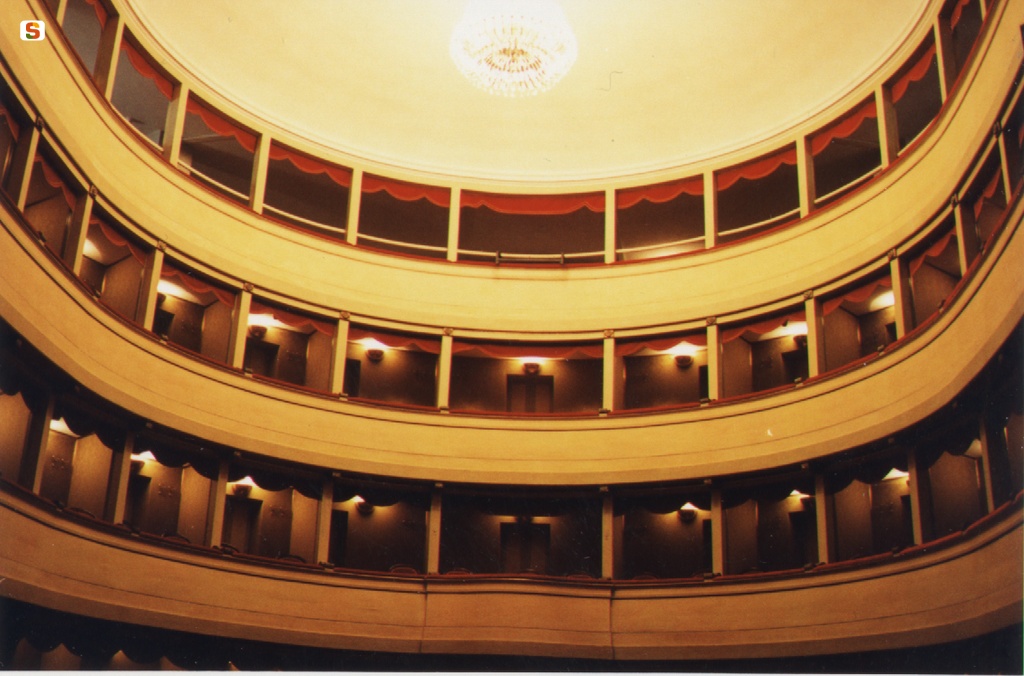
Inside you can admire the decorations that dominate the stage and the good quality of the recent restoration. Conceived with an audience, three orders of stages and a loggia, it follows the model of the civic theater in Sassari and the Margherita theater in Cagliari. The first performance was the opera Lucia di Lammermoor by Gaetano Donizetti. The stages, adorned with mirrors, were decorated with abundant gilding and a large bronze chandelier hung in the center of the painted vault. Stages, balustrades and seats were lined with amaranth red velvet. The restoration, completed a few years ago, has preserved the characteristics of the stage and theater room, paying particular attention to respect for acoustics, remarkable and well studied.
History of studies
A review of studies can be found in the bibliography relating to the fact sheet in the volume of the “History of Art in Sardinia” on nineteenth-century architecture (1992).
Bibliography
I. Principe, Sassari. Alghero, series “Cities in the History of Italy”, Bari, Laterza, 1983, p. 147;
S. Naitza, Architecture from the late 17th century to purist classicism. Nuoro, Ilisso, 1992, sheet 71.
How to get there
The Civic Theater can be reached by entering Via Principe Umberto, up to the “Plaça del Bisbe” or Theater Square.
Content type:
Civil architecture
Province: Sassari
Common: Alghero
Macro Territorial Area: Nord Sardegna
POSTAL CODE: 07041
Address: piazza del Teatro, 6
Update
Where is it
Images

Author : Teatro Verdi <Sassari>
Year : 1884
Results 2 of 105913
View All
Texts
Author : Satta Musio, Antonio
Year : 1878
Author : Satta Musio, Antonio
Year : 1878
Results 2 of 1328615
View All


 Facebook
 Twitter
 LinkedIn
 Whatsapp

 Print
Print
 E-mail
Comments