Subjects





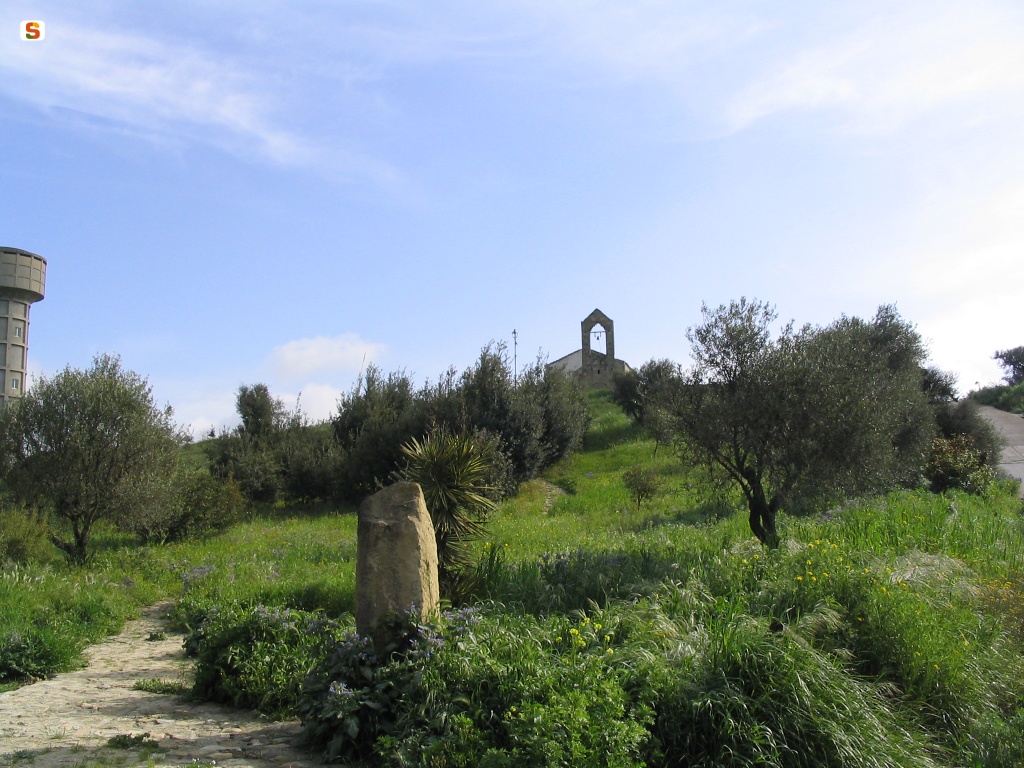
The town of Senorbì is located on a marshy plateau in Trexenta, a region in the central-southern part of Sardinia, rich in archaeological evidence. The “Sa Domu Nostra” Archaeological Museum was recently opened, mainly to house the finds of the Punic and Roman necropolis of Monte Luna, which has known settlements even before the Punic one. On the N outskirts of the town, the small country church of Santa Maria di Segolai stands on a hill.
In medieval times, Segolaj's “villa” was included in the curatorship of the Trexenta, of which it was the most important center, and was part of the Cagliari court. Along with other 'villas', on 20 July 1219 it was donated by the Cagliari judge Lamberto Visconti to his son Ubaldo, on the occasion of his marriage to Adelasia de Lacon-Gunale.
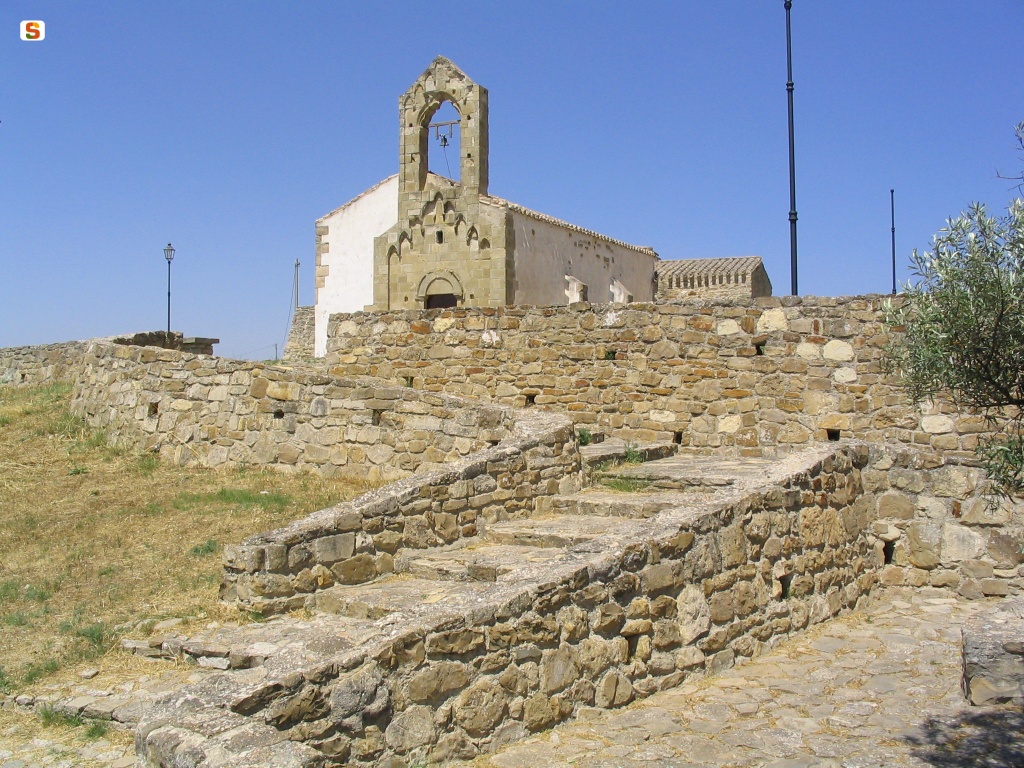
There is no documentary information on the Romanesque church, known in the area as Santa Mariedda. The plant can be placed chronologically in the last quarter of the 13th century. It had to have a single-aisle room, concluded by a semicircular apse. It was then expanded at the N side. In the façade, oriented to S/O, the part relating to the Romanesque factory, built in sandstone with rows of medium-sized square ashlars, neatly arranged, stands out clearly. The part relating to the second construction phase is instead built with unsquare and irregularly arranged stones.
The part corresponding to the Romanesque façade, enclosed in corner parasts and resting on a shoe-like clog, is concluded by an ascending theory of pointed hanging arches, with a double ring, resting on peducci. The portal opens there, without an lintels but with a bezel, which once had to be curved, whose eyebrow is set on small molded capitals. In line with the portal, the sailing bell tower rises, which has only one arching light, rather large and internally three-lobed, at the end of which there are pointed hanging arches, with a double ring, which rest on elongated peducci. The considerable size of the bell tower is disproportionate to the small size of the original façade, 4.62 m wide.
History of studies
In the 19th century, the church was registered by Abbot Vittorio Angius as being named after Saint Nicholas of Bari. In the twentieth century, the building was designed by Dionigi Scano (1907) and Roberto Coroneo (1993).
Bibliography
V. Angius, voce ''Senorbì'', in G. Casalis, Dizionario geografico storico-statistico-commerciale degli Stati di S.M. il Re di Sardegna, XVIII, Torino, G. Maspero, 1849, p. 876;
G. Spano, in A. Della Marmora, Itinerario dell'isola di Sardegna, Cagliari, Alagna, 1868, p. 178, nota 1;
G. Spano, Vocabolario sardo geografico patronimico ed etimologico, Cagliari, Alagna, 1872, pp. 101-102;
D. Scano, Storia dell'arte in Sardegna dal XI al XIV secolo, Cagliari-Sassari, Montorsi, 1907, p. 334;
M. Botteri, Guida alle Chiese medioevali di Sardegna, Sassari, Chiarella, 1978, p. 136;
La Provincia di Cagliari. I Comuni, a cura di N. Sciannameo-F. Sardi, Cinisello Balsamo, Silvana, 1985 (II ed.), p. 246;
R. Coroneo, Architettura romanica dalla metà del Mille al primo '300, Nuoro, Ilisso, 1993, scheda 130;
R. Coroneo, Chiese romaniche della Sardegna. Itinerari turistico culturali, Cagliari, AV, 2005, p. 89.
Content type:
Religious architecture
Province: South Sardinia
Common: Senorbì
Macro Territorial Area: South Sardinia
POSTAL CODE: 09040
Address: via Giuseppe Lonis, s.n.c. - località Parco di Segolay
Update
Where is it
Video


 Facebook
 Twitter
 LinkedIn
 Whatsapp

 Print
Print
 E-mail


Comments