Subjects





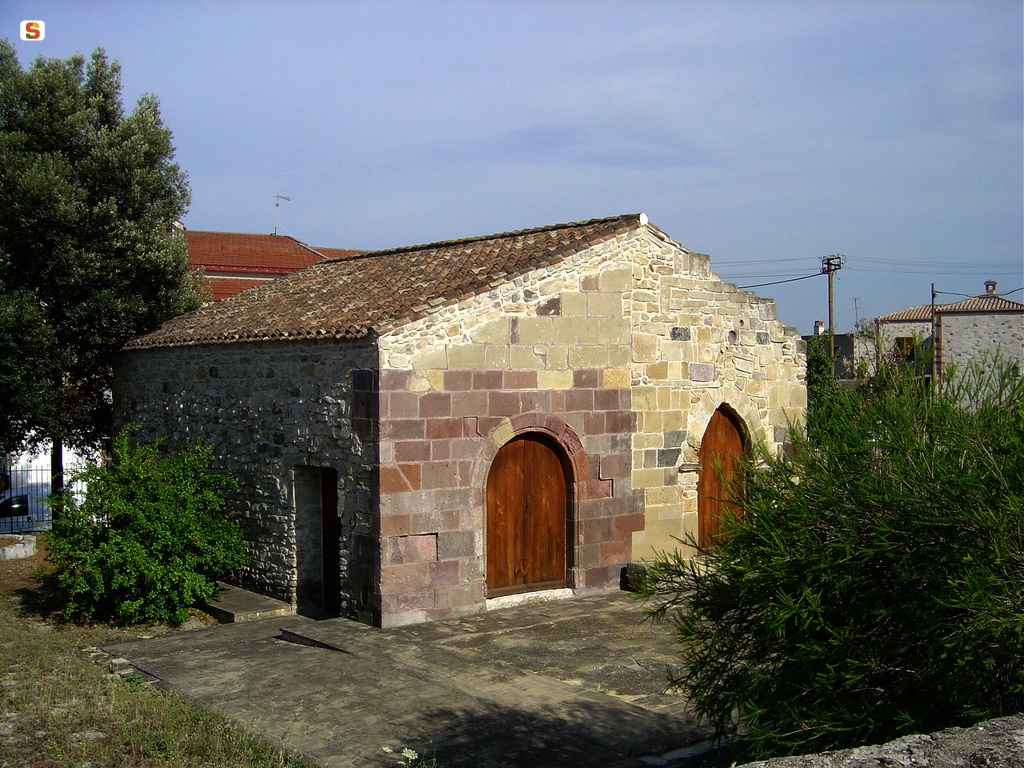
The town of Villamar is located on a terrace in lower Marmilla, in central-southern Sardinia. In the territory, frequented since the Neolithic period, there are interesting attestations from the Nuragic and Punic periods. The Romanesque building is located in the center of the old village, not far from the parish church of San Giovanni Battista.
Mara Arbarei's villa, today's Villamar, was part of the court of Arborea and was dependent on the curatorship of Marmilla, of which it was the capital, and on the diocese of Usellus (or Ales). It is recorded for the first time in a document dated October 29, 1206, which we know from the 16th century transcript of a copy of 1307, concerning the agreement signed between Guglielmo I-Salusio IV de Lacon Massa, judge of Cagliari, and his son-in-law Ugone I de Bas-Serra, judge of Arborea, to clarify the delimitation of the boundaries between the two judges. Mara Arbarei went to Cagliari, and then returned to the Arborea in 1258, after the fall of the Cagliari court.
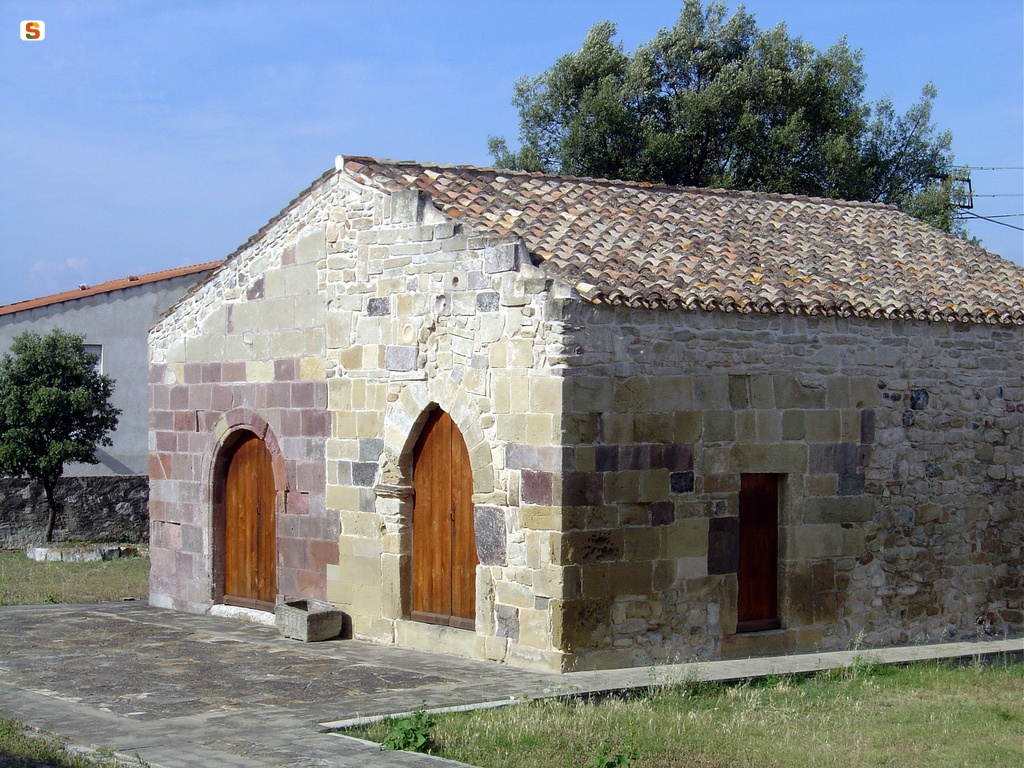
The church, made of sandstone and vulcanite, has two naves, each concluded by an S/E apse. It was built in two close phases, on which there is no documentation. The Romanesque building, located in the second half of the thirteenth century, dates back to the S. A short time later, the smaller N nave was built, with a shallower apse and a smaller diameter. The dividing septum consists of three large arches on rectangular pillars. The façade is concluded by a large sailing bell tower.
The building is based on a high plinth, from which large corner pilasters start and the pilasters that divide the walls in mirrors. Along the terminals, pointed arches cut flush, which sometimes open at the top with a tiny lobe. The elongated peducci show numerous ornamental motifs: cross shaped, geometric pattern, flower, sharp leaves with a curved top, with a dense gradation, with a molded section, with strips and shells, with human protomes.
History of studies
The church was designed by Dionigi Scano, who records lacerations of polychrome paintings on the trusses of the main aisle, and by Raffaello Delogu. For the latter, the N aisle and the sailing bell tower are the work of different workers from those who built the other one, whose constructive methods they tried to imitate. The “Arabesque” character of the decoration suggests the activity of craftsmen perhaps from Spain.
Bibliography
V. Angius, entry “Mara Arbarei”, in G. Casalis, Historical and Statistical-Commercial Geographical Dictionary, X, Turin, 1842, p. 128;
D. Scano, History of art in Sardinia from the eleventh to the fourteenth century, Cagliari-Sassari, 1907, pp. 74, 330;
R. Delogu, The architecture of the Middle Ages in Sardinia, Rome, 1953, pp. 183-184; The Province of Cagliari.
The Municipalities, edited by N. Sciannameo-F. Sardi, Cinisello Balsamo, 1985 (II ed.), p. 312;
R. Coroneo, Romanesque architecture from the mid-thirteenth century, Nuoro, Ilisso, 1993, page 136;
G. Murgia, “From the collapse of the Arborean court to the Aragonese-Spanish rule”, in Villamar. A community, its history, Dolianova, 1993, p. 163;
S. Mele, “Country Sheets”, “Works Sheets”, in Inside the Marmilla. Environment, History, Culture, Lunamatrona, 2000, sch. 8, 8.1;
R. Coroneo, Romanesque Churches of Sardinia. Cultural tourist itineraries, Cagliari, 2005, p. 82.
How to get there
Leave the SS 131 to take the SS 197 which leads, after less than 10 km, to Villamar, where the church of San Pietro is located.
Content type:
Religious architecture
Province: South Sardinia
Common: Villamar
Macro Territorial Area: South Sardinia
POSTAL CODE: 09020
Address: via Vittorio Emanuele, s.n.c.
Update
Where is it
Villamar, Chiesa di San Pietro Images number: 7
Texts

Year : 2000
Year : 2000
Results 2 of 1388188
View All
Audio


 Facebook
 Twitter
 LinkedIn
 Whatsapp

 Print
Print
 E-mail
Comments