Subjects





The archaeological area is at the top of two contiguous hill reliefs, separated by a saddle, which rise to the W of the plain behind the beach of Orrì, on the Ogliastra coast, in eastern Sardinia.
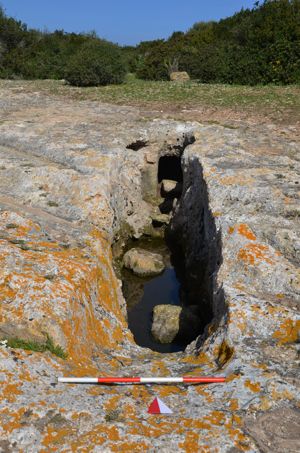
The complex includes a nuraghe with an antewall and adjoining village, a tomb of giants, three menhirs and a second curtain wall. In addition, an underground tomb is excavated on the N side of the relief.
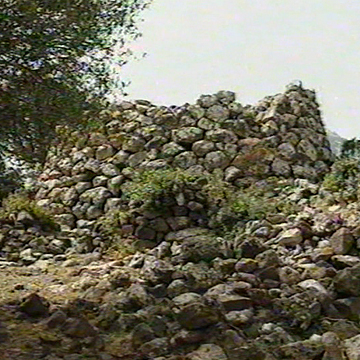
The nuraghe - in very poor condition of conservation - is a single-tower. The tower has an S-oriented trapezoidal entrance - partly underground - covered by lintels with an exhaust window above it.
The entrance leads into a flat entrance that has on the left wall the staircase - with an ogival cover - that led to the upper floors.
The entrance leads into a circular chamber, now raised and partly filled with collapse, which shows three niches arranged in a cross: the subsidiary compartment has an elongated floor plan (m 1.70 x 2.50; h m 1.55), with walls jutting towards the ogive closure; the one on the right, semicircular (width m 0.95; depth m 1.10; h m 1.10, has a flat roof). The coaxial niche at the entrance is currently not accessible.
The walls of the chamber are built with irregular rows of granite blocks reinforced with wedges.
The antewall (m 43 x m 34.80; h m 4.26) - built with large blocks of granite that have just been sketched and superimposed without special care - incorporates in its path at least three towers: two larger, in S and N, and a smaller one in O. The access was through three entrances: to E, to S and to N-O (the latter obliterated).
The excavation has revealed the presence of numerous huts outside the antewall, and some structures that lean against the same wall. Two circular huts, in S-O and S-E, which had a central fireplace, have returned numerous materials related to everyday life (ceramics for use, millstones and pestles, etc.). At the S-E hut, almost close to the antewall, nine “siloes” have been unearthed for the preservation of foodstuffs: the discovery of numerous remains of grains suggests an accumulation of “surplus” destined for trade and trade.
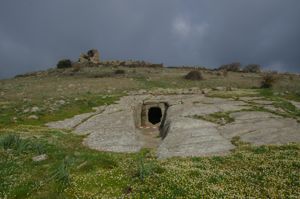
The tomb of giants is located on the saddle downstream of the relief on which the nuraghe stands, on a gently sloping terrain.
The burial - of the row type with curved stele - preserves, in part, the apsidic tomb oriented to E (length 15.50 m; width 10.60 m; h m 1.40) and built with medium-sized polyhedral granite and porphyry blocks. The short rectangular inner corridor has the walls formed by basic orthostats on which three rows of sketched blocks rest; the floor plan consists of the outcropping rock.
The burial dates back to around 1500 BC.
The hemicycle of the exedra, with rather open wings, is pressed at the base by a crackle; in the center, the entrance opens, today without the curved bilitic stele that is scattered on the country level.
The three granite menhirs are located on the slope of the saddling: the first aniconic (length m 4.25; width m 0.98; thickness m 0.60) - pointed and fractured in two sections - is lying on the ground; the second (length m 2.65; width m 1.30; thickness m 0.80) - raised in the 70s - is of a protoanthropomorphic type with an ogival shape and a plano-convex section; the third (length m 3.60; width m 0.80) - raised in the 70s - is of the protoanthropomorphic type with an ogival shape and a plano-convex section; the third (length m 3.60; width m 0.80) - raised in the 70s - is of the protoanthropomorphic type with an ogival shape and a plano-convex section; the third (length m 3.60; width m 0.80) - raised in the 70s - is of the protoanthropomorphic type with an ogival shape and a plano-convex section; the third (length m 3.60; width m 0.80) - raised in the 70s - is of the protoanthropomorphic type 98; thickness m 0.50), also protoanthropomorphic, has an ogival shape and a flattened plano-convex section.
History of excavations
The area was excavated by Maria Ausilia Fadda in 1990-91.
Bibliography
The Nuragic Civilization, Milan, 1985, p. 7; C. Locci, in Progetto I Nuraghi: archaeological reconnaissance in Ogliastra, Barbagia, Sarcidano, Milan, Consorzio Archeosystem, 1990, p. 72; G. Cabras, “The Nuragic Complex: Tortolì - Nuoro, Loc. S'Ortali e su Monte”, in Bulletin of Archaeology, 13-15, 1992, pp. 181-184.
How to get there
From Tortolì you take the road to the beach of Orrì. About km 2, near an Enel electric cabin, there is a tourist sign that indicates the archaeological park of San Salvatore. You pass the first detour to d., continue for about 200 m and always on the d. there is another junction. Take it and follow the road for about 100 m: the nuraghe is on the right of the road while the tomb of the giants and the menhirs are on the left.
Content type:
Archaeological complex
Archaeology
Province: Nuoro
Common: Tortolì
Macro Territorial Area: Central Sardinia
POSTAL CODE: 08048
Address: località S'Ortali e Su Monti
Telephone: +39 334 1046853
Information on tickets and access: In order to use the services, you must refer to the Sardinia Cultural System Consortium: go to the website.
Update
Where is it
Texts

Author : Franco, Niccolò <1515-1570>
Year : 1554
Author : Chiesa Cattolica
Year : 1719
Results 2 of 1537645
View All
Video


 Facebook
 Twitter
 LinkedIn
 Whatsapp

 Print
Print
 E-mail
Comments