Subjects





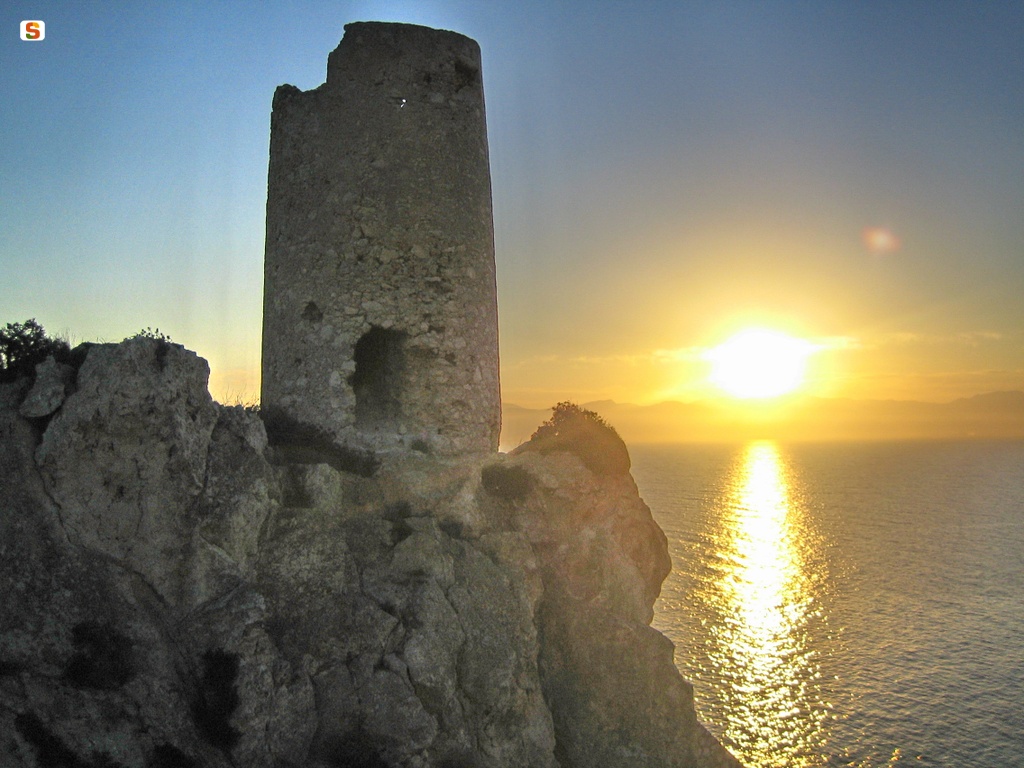
The tower, which had always been called San Giovanni di Sarralà or Tertenia, controlled the area between the Quirra and Capo Sferracavallo, to prevent any landings by Barbarians.
The tower, made of granite cones, has a truncated conical shape. The height up to the paving of the upper terrace is 11 m, the base diameter 12.30 m. The original entrance opened towards O at a height of 4.5 m above the ground and was protected, on the upper floor, by a box; the gate is currently not in place, but traces of it remain in the wall. On the first floor there is the casamatta, the vaulted bombproof room, which has, in structure, characteristics similar to those of contemporary Cannai and Calasetta. In the parade square, that is, on the upper terrace, connected to the casamatta through a central hatch, there are, on the sea side, gunboats with battlements and spaces reserved for cabins. Leaning against the parapet to the ground, the crescent was built, a light structure, with a semicircular shape, made of rods and blocks, whose purpose was to protect the ammunition and the men of the tower for the night.
There is no reliable information on the date of construction of the tower, as there is no evidence of its existence in 17th century maps. It appears for the first time, designed by Colombino, in “Nova et Accurata Totius Sardiniae Tabula”, in the year 1720. The tower would therefore date back to the first decades of the 18th century. It was built mainly to compensate for the lack of defense of the coastal area between Capo San Lorenzo del Salto di Quirra and the tower of Barì, but above all to monitor the underlying “French Cove”, frequently visited by flotillas of Moors.
The tower was visited by the Piedmontese Ripol, in 1767, who described it as a “gagliarda” tower, for heavy defense, equipped with four cannons, four pushes, eight rifles and a garrison composed of a “warden” (the captain of the tower), an artilleryman and four soldiers (reduced to three in 1794). In 1798, some repair work was documented.
In 1812, the tower was besieged by Tunisian warships that had also attacked the towers of Porto Giunco, Cavoli and Serpentara; for about 10 hours the warden and the torrieri resisted the barbarian onslaught, until the arrival of a contingent of militiamen who repelled the attackers. The tower suffered several damages, such as the collapse of part of the Santa Barbara and the fire in the hatch. Finally, in 1829, designed by the royal architect Melis, it was repaired, together with those of Capo Ferrato and Porto Corallo.
In 1851, nine years after the Royal Administration of the Towers was suppressed, the tower was abandoned. During the Second World War, it was renovated and adapted to a bunker, causing the original spaces to change; the tank, inside, was equipped with a circular walkway with eight loopholes arranged in a radial pattern, while a new staircase connected this room with the room on the first floor, in turn equipped with as many openings for machine guns. The 1990 restoration partially restored the original condition.
History of studies
The tower is included in the main works on coastal fortifications in Sardinia.
Bibliography
E. Pillosu, The coastal towers in Sardinia, Cagliari, La Cartotecnica Typography, 1957;
F. Fois, Spanish towers and Piedmontese forts in Sardinia, Cagliari, La Voce Sarda, 1981;
G. Montaldo, The coastal towers in Sardinia, Sassari, Carlo Delfino, Sassari 1992;
F. Russo, The coastal defense of the Kingdom of Sardinia from the 16th to the 19th century, Rome, Army General Staff, Historical Office, 1992; G. Montaldo, "Forts and Coastal Towers “, in The Architecture
fortresses of central-southern Sardinia. Proceedings of the Study Day, Cagliari, October 16, 1999;
M. Rassu, Guide to coastal towers and forts, Cagliari, Artigianarte, Cagliari 2000.
How to get to
Tertenia is along the SS 125 (eastern Sardinia). From the town, to reach the tower, you have to take the provincial road that runs along the Rio Sibili and that leads to the sea in the direction of Torre di San Giovanni.
Content type:
Fortified architecture
Province: Nuoro
Common: Tertenia
Macro Territorial Area: Central Sardinia
POSTAL CODE: 08047
Address: località Foxi Murdegu
Update
Where is it
Texts

Author : Serra, Luigi
Year : 2017
Author : Serra, Luigi
Year : 2017
Results 2 of 1608823
View All
Video


 Facebook
 Twitter
 LinkedIn
 Whatsapp

 Print
Print
 E-mail

Comments