Subjects





The territory between Uri and Ittiri offers a landscape that alternates rolling hills with rugged reliefs of sedimentary rock. Our Lady of Paulis was built along the route of a Roman road, later called “s'istrada de sos Padres' because it connected this abbey to the abbey, also Cistercian one, of Santa Maria di Corte in the territory of Sindia. It owes its name to the marshy area in which it was built, hence the name Paludis or Padulis.
The Abbey of Our Lady of Paulis was established in 1205, following a donation by the King of Torres Comita II to the Cistercian Benedictines, and remained active as a monastic community until the 15th century. The limestone walls have the characteristics of the Cistercian workers who worked in Sardinia between the 12th and 13th centuries.
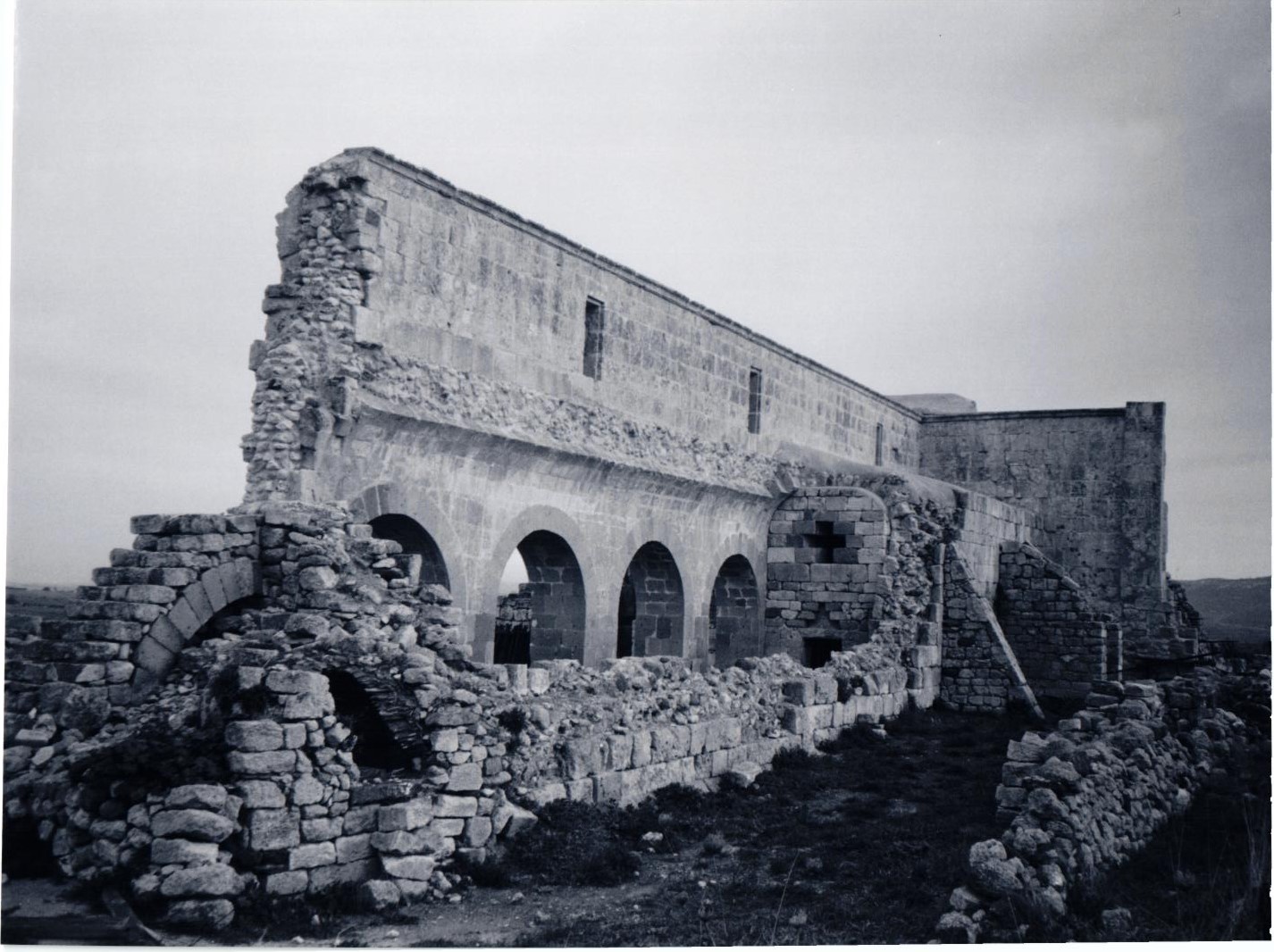
The complex, reduced to ruins, has been restored several times. Remains of the cloister and some rooms of the convent adjacent to the abbey can be found around the main building.
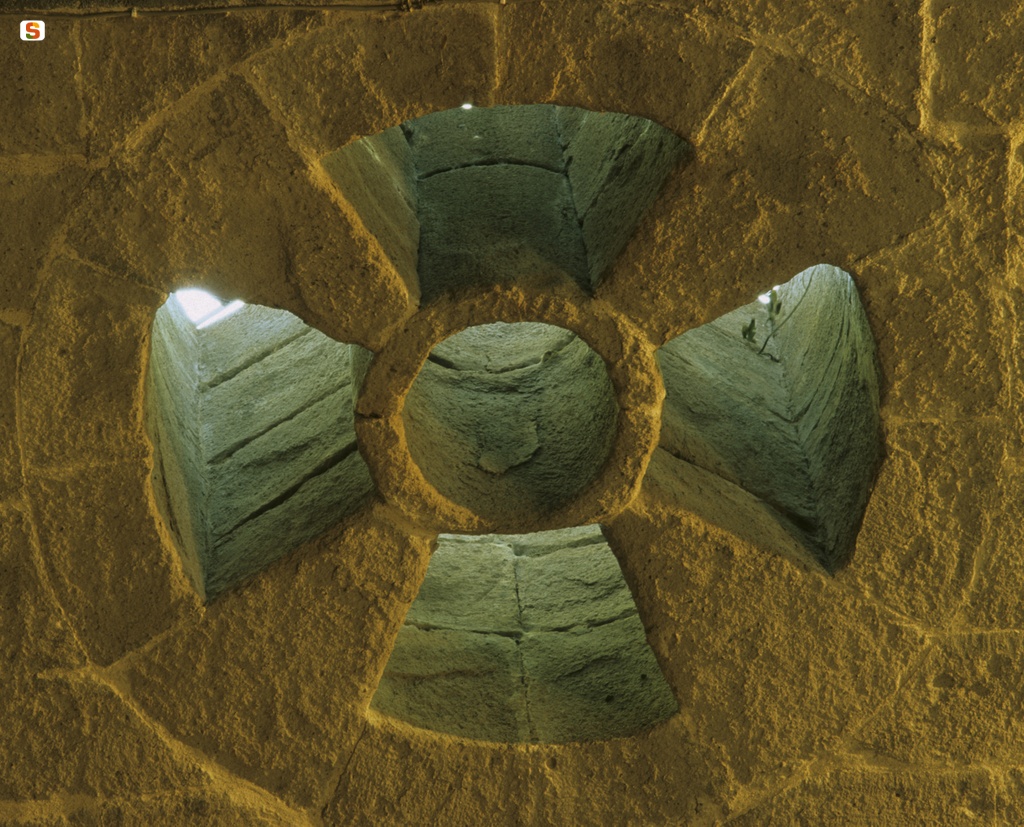
The church was shaped like a “commission” cross, that is, with three naves punctuated by arches on pillars and a barely protruding transept. The transept overlooked the square-shaped apse and two chapels, one on each side. The spaces were turned upside down. In the perfectly oriented N wall of the apse, there was a closet; on the opposite side, a Latin cross window opened. On the E side of the choir, a window was opened, surmounted by a single window (a reference to the Trinity) in which a panel with a Greek cross was placed.
History of studies
Studies on the Abbey of Our Lady of Paulis are intertwined with those on the presence of Cistercian monks on the island. After World War I, Raffaello Delogu's (1948) work on Cistercian architecture in Sardinia came out, followed in 1976 by that of Ginevra Zanetti. From 1990 are the proceedings of the conference on Cistercians in Sardinia held in Silanus in 1987. Finally, see Roberto Coroneo's profile (1993).
Bibliography
V. Angius, “Iteri-Cannedu”, in G. Casalis, Historical-Statistical-Commercial Geographical Dictionary of the States by H.M. the King of Sardinia, VIII, Turin, G. Maspero, 1841, pp. 562-568;
V. Angius, “Sassari”, in G. Casalis, Historical and Statistical and Commercial Geographical Dictionary of the States of His Majesty the King of Sardinia, XIX, Turin, G. Maspero, 1849, pp. 71-375; R. Delogu, “Cistercian Architectures of Sardinia”, in Sardi, VIII, 1948, pp. 99-131; R. Delogu, Architecture
of the Middle Ages in Sardinia, Rome, The State Library, 1953, pp. 141-143;
G. Zanetti, “The Cistercians in Sardinia, The Abbeys of S. Maria di Corte, of Paulis and of Coros”, in the Sardinian Historical Archive of Sassari, II, 1976, pp. 18-20;
R. Serra, Sardinia, series “Romanesque Italy”, Milan, Jaca Book, 1989, pp. 418-419; M.C. Cannas, “Cistercian decorations in the Cistercian churches of Sardinia”, in I in Sardinia.
Aspects and problems of a Benedictine monastic Order in medieval Sardinia, edited by G. Spiga, Nuoro, Provincial Administration of Nuoro, 1990, pp. 245-277;
A. Casula, “Testimonies of Cistercian Architecture in Northern Sardinia”, in The Cistercians in Sardinia. Aspects and problems of a Benedictine monastic Order in medieval Sardinia, edited by G. Spiga, Nuoro, Provincial Administration of Nuoro, 1990, pp. 223-243;
R. Coroneo, Romanesque Architecture from the Mid Thousand to the Early '300, Nuoro, Ilisso, 1993, sheet 59; R. Coroneo, Romanesque Churches of Sardinia.
Tourist-cultural itineraries, Cagliari, AV, 2005, p. 28.
How to get there
Ittiri can be reached by the SS 131 bis from Sassari. To get to the ruins of the church of Our Lady of Paulis, you have to travel 8 km, to the exit for Uri; from here you continue in the direction of Ittiri for just over a km. On the road you can see the ruins of the church.
Content type:
Religious architecture
Province: Sassari
Common: Ittiri
Macro Territorial Area: Nord Sardegna
POSTAL CODE: 07044
Address: SP 15
Update
Where is it


 Facebook
 Twitter
 LinkedIn
 Whatsapp

 Print
Print
 E-mail


Comments