Subjects





Guspini, in Medio Campidano, is known for its proximity to the Gentilis forest and the basalt quarry with vertical columns, as well as for the presence of numerous archaeological sites. The parish church of San Nicola, bishop of Mira, is located in the village, above a natural hill reinforced by bastions, accessible through a granite staircase.
The Guspinese parish church of San Nicola is characterized by the beautiful rose window that stands out on the façade, scenographically overlooking the main square of the town.
The construction work began in 1611, following a fundraiser, with the order of the rector Antiogo Uda to the picapedrers Giovanni Antonio Pinna and Antiogo Flores. Between 1625 and 1630, the building was completed and used in full its functions as a parish church.
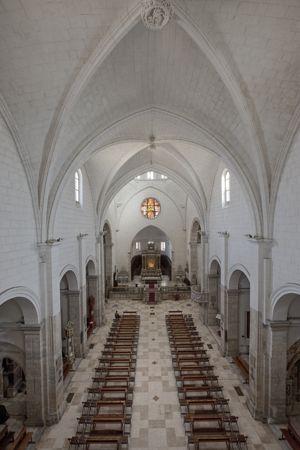
San Nicola looks like a composite factory, due to interventions that have taken place over the years: originally the church had to have a “inserted” Latin cross, with a wooden roof. In the middle of the 17th century, four chapels were opened, two on each side, followed by the construction of the bell tower, finished in 1723, with a square plan and flat finish, and other chapels for a total number of eight. The wooden roof gave way to a barrel vault supported by grooves.
The interior of the church is a perfect fusion of late Gothic and Renaissance elements, mixed in an eclectic style typical of the 17th century of the island. The decorations of the round arches of the chapels and the presbytery are significant, with diamonds and rose windows in a geometric grid.
The façade has a flat finish, adorned with a series of combed battlements; in the center is the portal, a truly original element of the whole complex. In fact, the entrance to the church is framed by a thin frame that ends in an arch similar to those shaped like a horseshoe, however, mediated by a pointed arch; in the upper corners of the frame there are two niches housing two marble heads resting on a capital with phytomorphic decoration. A third head had to be placed at the top of the arch above the portal.
In the upper part of the façade there is the rose window, enclosed by a worked frame, with a very dense tunnel decoration that brings it closer to the type of Catalan rose windows, which are not very common on the island compared to the majority similar to models from the south of the Italian Peninsula.
History of studies
The history of studies starts from the entry 'Guspini' by Vittorio Angius, in the 'Dictionary' of Casalis (1841). Only in the following century was the church organically studied, thanks to documentary sources that clarify its chronology. Cited in the studies of Corrado Maltese and Renata Serra (1969) and the latter and Giorgio Cavallo (1974), in 1992 it was placed in the 17th century by Edmondo Locci. The fact sheet contained in the volume by Francesca Segni Pulvirenti and Aldo Sari on late-Gothic and Renaissance-influenced architecture (1994) agrees with this date.
Bibliography
V. Angius, “Guspini”, in G. Casalis, Historical and Statistical-Commercial Geographical Dictionary of the States of His Excellency the King of Sardinia, VIII, Turin, G. Maspero, 1841, pp. 299-308;
A. Florensa, “The position of the Gothic in Sardinia (General Report)”, in Proceedings of the XIII Congress on the History of Architecture, Sardinia, I, Rome, 1966, pp. 213-223; C. Maltese-R. Serra, “Episodes of an anti-classical civilization”, in Sardinia, Venice, 1969, p. 314;
R. Serra-G. Cavallo, “The sanctuary of San Mauro in Sorgono (Nuoro)”, in Studi Sardi, XXIII, 1974, p. 241, p. 246, note 9, note 28 bis;
R. Serra, “Sardinian-Catalan architecture”, in The Catalans in Sardinia, edited by J. Carbonell-F. Manconi, Cinisello Balsamo, Amilcare Pizzi, 1984, pp. 125-154; E. Locci, Guspini. Civil and religious history of a people, Oristano, 1992, pp. 39-215;
F. Segni Pulvirenti - A. Sari, Late Gothic and Renaissance-influenced architecture. Nuoro, Ilisso, 1994, sheet 68.
Content type:
Religious architecture
Province: South Sardinia
Common: Guspini
Macro Territorial Area: South Sardinia
POSTAL CODE: 09036
Address: piazza XX Settembre, s.n.c.
Update
Where is it
Guspini, Chiesa di San Nicola di Mira Images number: 2
Texts

Author : Serra, Dante
Author : Serra, Dante
Results 2 of 1557623
View All


 Facebook
 Twitter
 LinkedIn
 Whatsapp

 Print
Print
 E-mail
Comments