Subjects





The dolmen is located on a short basaltic plateau (214 m above sea level), near the remains of the homonymous nuraghe.
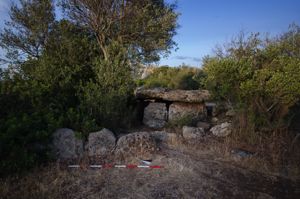
The Motorrá burial is a rare example of a corridor dolmen.
Built in basalt stone, it has a hexagonal plan (m 1.80 x 2.10 x 0.80) delimited by eight rectangular slabs, well worked on the inside, and covered by a single irregular pentagonal slab (m 3.00 x 2.90; thickness m 0.35/0.30).
The burial room is accessed through an entrance, facing S-SO, which still preserves the now fragmented manhole in situ.
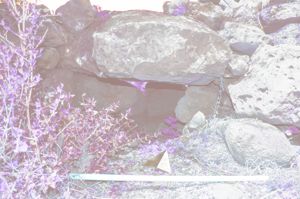
The entrance leads into a short corridor - lower in height than that of the burial chamber - originally formed by four orthostats and covered by three slabs now moved.
The burial is enclosed by a double elliptical peristalite (m 4.90x4.10), consisting of eleven residual slabs. The structure was functional to support the mound of tiny earth and stone that covered the tomb.
On the W side of the persitalite, in the NW direction of the tomb, there are three slabs placed side by side and fixed with a knife on the ground (about 2 m long): the orthostats have been interpreted by some scholars as the remains of a reinforcement wall along the area most exposed to the elements, by others as a residual part of a second, more external peristalite.
The materials recovered following clandestine interventions make it possible to date the grave and to reconstruct the different phases of use. The oldest and most significant finds are four fictile fragments of the Ozieri culture. They also found: two chalcedony beads, a unique bone amulet in the shape of a human head (height 1.9 cm), a small sandstone “brassard” (length cm 4.4; width m 2.1) and some ceramics from the Bonnanaro culture.
History of excavations
Information not available.
Bibliography
G. Lilliu, “The Motorran Dolmen (Dorgali, Nuoro)”, in Studi Sardi, XX, 1966, p. 74 ff.;
G. Lilliu, The Sardinian Civilization from the Paleolithic to the Nuraghi Age, Turin, Nuova ERI, 1988;
M.L. Ferrarese Ceruti, “Le domus de janas di Mariughia and Canudedda and the dolmen of Motorrha”, in Dorgali. Archaeological documents, Sassari, Chiarella, 1980, pp. 57-65; M.R. Manunza, Dorgali.
Ancient monuments, Oristano, S'Alvure, 1995;
A. Moravetti, Serra Orrios and the archaeological monuments of Dorgali. Sassari, C. Delfino, 1998 (Archaeological Sardinia. Guides and itineraries; 26).
How to get there
From Dorgali, take the SS 125 to Orosei. Before the 207 km sign, there is a small road on the left, marked by a sign; you leave the car and follow a very narrow and rugged path between two terrains, for about 400 meters. Then you cross a wooden gate on the left, which signals the entrance to the area where the dolmen is located. After entering, go forward for 50 meters: the dolmen is on the right.
Content type:
Archaeological monument
Archaeology
Usability: unmanaged site
Province: Nuoro
Common: Dorgali
Macro Territorial Area: Central Sardinia
POSTAL CODE: 08022
Address: SS 125 - località Motorra
Update
Where is it
Dorgali, Dolmen di Motorra Images number: 1


 Facebook
 Twitter
 LinkedIn
 Whatsapp

 Print
Print
 E-mail


Comments