Subjects





The church is part of the Minimi convent complex.
Founded by Saint Francis of Paola (1416—1507), the order was approved in 1474 under the name of the Pauline Hermit Congregation of Saint Francis of Assisi; it later became the Order of the Minims.
The Fathers arrived in Sardinia in 1625; in the middle of the 17th century they received a donation of land near the port where, by the end of the century, they built the current convent and the church adjacent to it.
The building, like a classroom, with three altars on each side and a deep rectangular presbytery, had a façade with a “carabiniere's lamp” terminal and a portal framed by pairs of Corinthian columns. These characteristics appear for the first time in Cagliari in the church of the Confraternita dei Genovesi, dedicated to SS. Giorgio and Caterina (destroyed by the bombings of 1943) and built by 1615, and in the church of the Society of Jesus, dedicated to Jesus, Mary and Saint Teresa, whose construction began in 1623; a common point of reference, for both, is the Mannerist architectural taste of the Counter-Reformation, which in Sardinia merged with Gothic-Catalan modes.
The double-inflected crown of the façade is also present, in Cagliari, in the churches of Santa Chiara and Santa Restituta, both from the first decades of the seventeenth century.
Unfortunately, the façade of San Francesco, in 1926, was considered devoid of artistic interest and demolished. The new, neoclassicist prospectus, designed by engineer Ferraro and inaugurated in 1932, responded to the artistic taste of the fascist regime; the urban culture of those years also included “alignment solutions to the arcaded facades of Via Roma, dating back to the end of the nineteenth century”.
The interior, on the other hand, has maintained its seventeenth-century structure. The barrel vault of the classroom is set on a molded frame that runs without solution to the presbytery; the sub-arches that reinforce it unload grooved pilasters attached to the pillars onto the Ionic capitals.
Among the latter, there are, on alternate occasions, architectural newsstands and altars, included in round arches with a boxed intradosx.
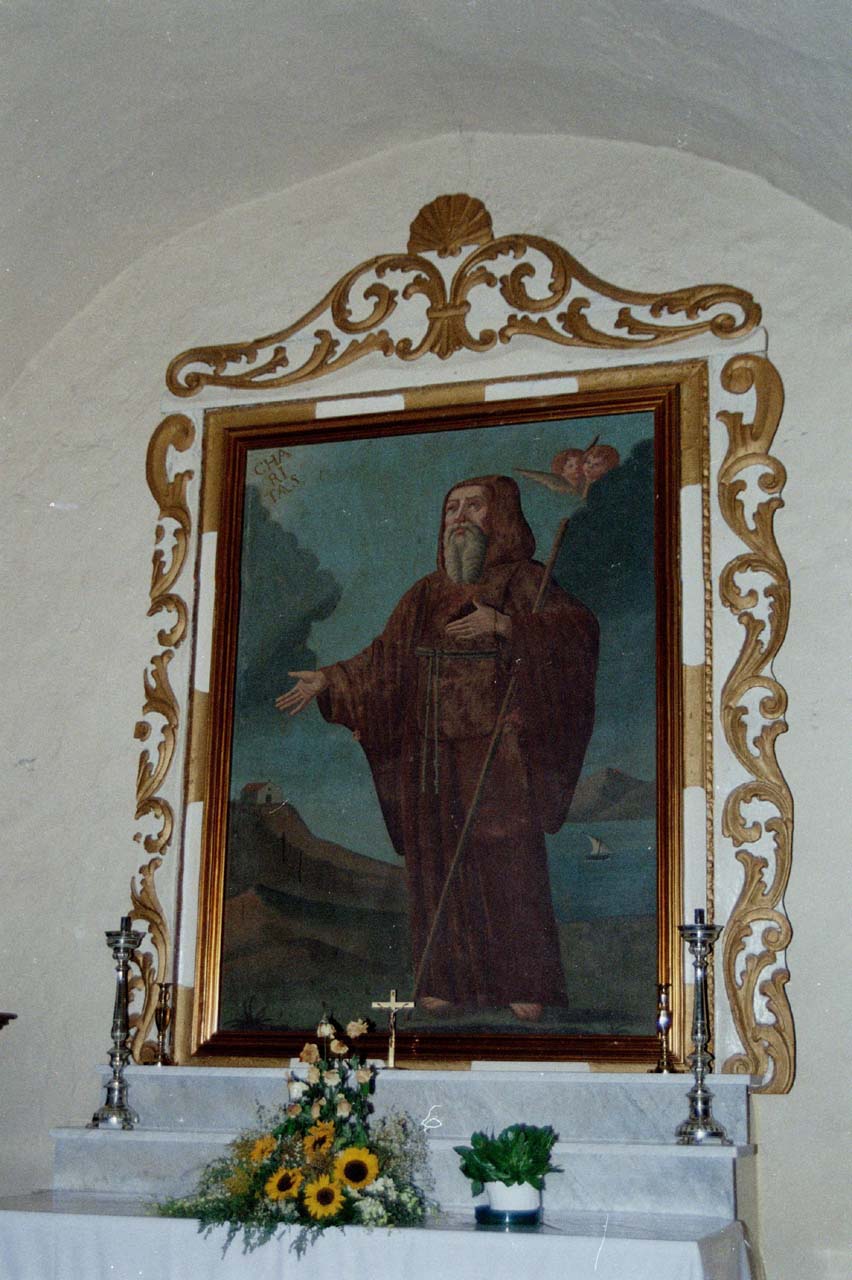
The presbytery, built on a two-room crypt intended for the burial of the friars, is raised by four steps. Its furniture, in polychrome marble, was executed by the Lombard Giovanni Battista Spazzi (1745 - 1797) by 1793; the altar has a rectangular pole with angular volutes and a central coat of arms set out by the bas-relief image of Saint Francis of Paola who miraculously crosses the Strait of Messina; the niche houses the eighteenth-century wooden simulacrum of the Saint; the balustrade that closes it is set in the center on two lions.
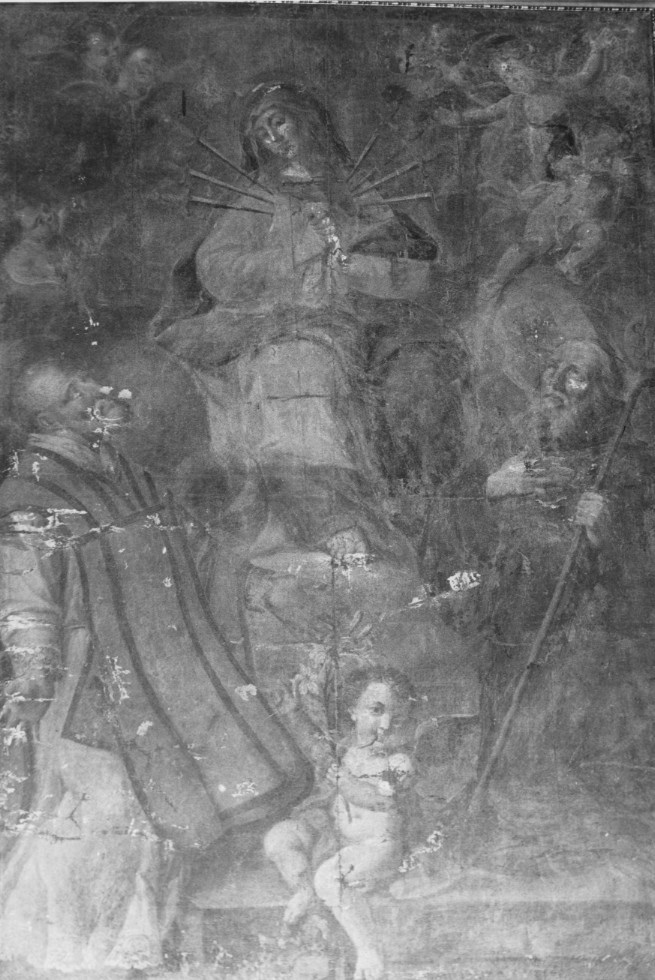
The first altar on the left, with a rectangular base in inlaid marble (early 18th century) houses, inside a wooden newsstand, an oil painting on canvas by the Genoese Pantaleone Calvo (active in Sardinia between 1631 and 1664), depicting the Virgin and Child and Saint Francis of Paola who intercedes for the souls of Purgatory, signed and dated 1664.
The third altar on the left and the third on the right are valuable works in gilded and polychrome wood with sumptuous baroque frames, attributed to the workshop of the Recupo, Sicilian cabinetmakers documented in Sardinia between the end of the 17th century and the beginning of the 18th century; in the first a canvas depicting two angels holding the symbol of the Minims, traced back to the painter Sebastiano Scaleta (active in the first half of the 18th century) and, in the niche, the sculptural group with Saint Michael who kills the Dragon (18th century).
In the second, a canvas depicting the Madonna and Child giving the rosary to Saint Domenico, also probably the work of Scaleta; in the niche a Madonna Enthroned with Child in gilded and polychrome wood, perhaps from a Neapolitan workshop (15th century).
In the third newsstand on the left, a “clothed” statue of Our Lady of Sorrows, attributed to an 18th century Neapolitan workshop; below, a small alabaster sculpture of the Deposed Christ, dated to the 18th century.
The lunette and vault of the presbytery were decorated by the Cagliari painter Bacicia Scano in the first decades of the 20th century; it features, respectively, the Canonization of Saint Francis of Paola and The Eternal in Glory with the Dove of the Holy Spirit.
During the restoration work of 1997-99, fragments of frescoes, perhaps from the seventeenth century, were found; detached and mounted on canvas, they are now placed in the sacristy.
Bibliography
G. Spano, Guide to the city and surroundings of Cagliari, Cagliari, Timon, 1861;
T.K. Kirova, “The practice of restoration in the architectural and urban interventions of the neighborhood”, in Cagliari Historic Districts. Marina, Cinisello Balsamo, Silvana, 1989;
M. Pintus, “Church of S.Francesco di Paola”, historic districts in Cagliari. Marina, Cinisello Balsamo, Silvana, 1989;
M.G. Scano, 17th and 18th century painting and sculpture, series “History of Art in Sardinia”, Nuoro, Ilisso, 1991;
M.G. Scano, “Seventeenth-century painting”, in Sardinian society in the Spanish age, edited by F. Manconi, Quart, CRS, 1993;
A. Piseddu, “The Cagliari Churches: Saint Francis of Paola”, in Almanacco di Cagliari, 2004, without pages; I. Farci, “Ligurian and Lombard master marbles active in Sardinia from the mid-eighteenth century to the first decades of the nineteenth century
“, in Quaderni Oristanesi, 51-52, 2004
Content type:
Religious architecture
Province: Cagliari
Common: Cagliari
Macro Territorial Area: South Sardinia
POSTAL CODE: 09124
Address: via Roma, s.n.c.
Update
Where is it
Texts

Author : Amat di San Filippo, Paolo
Year : 1993
Author : Renfrew, Colin
Results 2 of 1705690
View All
Video


 Facebook
 Twitter
 LinkedIn
 Whatsapp

 Print
Print
 E-mail
Comments