Subjects





Located on the outskirts of the city of Sassari, in what was once open countryside, the church overlooks a large square, accessed by a long avenue that flanks the walls of the convent's olive grove.
The foundation of the church and the Benedictine abbey attached to it, according to the “Libellus Judicum Turritanorum”, should be placed between 1065 and 1082, during the magistrate of Mariano I de Lacon Gunale. Only the first two lower orders of the bell tower remain of the Romanesque building, the work of workers active on the island in the 13th century, and some sections of the single-aisled hall.
Towards the end of the 16th century, work began on the renovation of the complex, which had passed to the management of the Franciscan Minors as early as the middle of the previous century. They were completed by 1641, according to the date engraved on the lintel of the entrance door to the cloister. But even earlier, changes were made to the church, starting with the addition in 1473-75 of the chapel of the Madonna delle Grazie (the first in N), according to the tradition erected following the miraculous discovery of the simulacrum of the Virgin, during a sermon given by Brother Bernardino da Feltre in the square in front of the building. Around the middle of the 16th century, the other two side chapels were built. The seventeenth-century renovation, responsible for the current appearance of the building, ended at the end of the century with the reconstruction of the façade, thanks to the legacies of the Cagliari native Antonio Mereu.
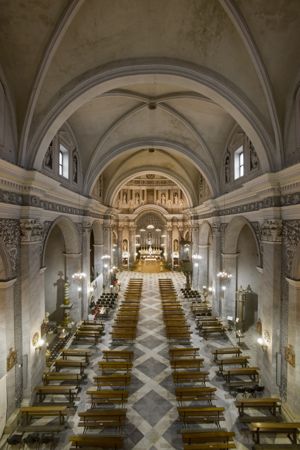
Three side chapels of different sizes overlook the only aisle of the church, all on the O side of the building; on the other side, in fact, there is what used to be the ancient monastery, now used as a shelter for the elderly. The chapel of the Madonna delle Grazie is covered by a cross vault equipped with a pendulous gem on which a Madonna and Child is carved; it is accessed through an ogival arch supported by polystyle pillars, culminating in capitals carved with sacred figures, of Gothic-Catalan taste. In the 17th century reconstruction, it was expanded with a rectangular-shaped room, covered by a sail vault, and with another barrel vault that houses a marble altar. The other two chapels on the same side, with a rectangular plan, have barrel and cross roofs respectively. A fourth chapel opens into the presbytery on the E side of the building, covered by a lunette vault, and houses a seventeenth-century wooden altar that contains one of the oldest statues of the Virgin on the island.
The original wooden truss roof of the room in 1672 was replaced with a lunette barrel vault. A choir is carved above the entrance hall.
The façade of the church is divided horizontally in two orders by a frame and vertically by four pilasters. In the three sections resulting in this way, three arches open in the lower part, including the central one with the entrance gate, and in the upper part, corresponding to the choir of the interior, three rectangular windows, two of which are timpaned. Above the entrance arch, there is the coat of arms of Mereu, who financed the reconstruction of the façade, decorated with late-manneristic phytomorphic motifs. The crowning is semicircular, as in the Sassari church of Jesus and Mary (today Saint Catherine).
History of studies
The church is the subject of a brief sheet in the volume by Francesca Segni Pulvirenti and Aldo Sari on late Gothic and Renaissance architecture (1994) and is fully analyzed in that of Marisa Porcu Gaias on the urban and architectural history of Sassari (1996).
Bibliography
R. Salinas, “The Evolution of Architecture in Sardinia in the Seventeenth Century”, in Studi Sardi, XVI, 1958-59; C. Maltese, “Persistence of archaic motifs between the 16th and 18th centuries in Sardinia”, in Sardinian Studies, XVII, 1959-61;
V. Mossa, Sassari, Gallizzi, 1988; R. Coroneo, Romanesque Architecture from the mid-thousand to the early '300.
Nuoro, Ilisso, 1993, sheet 110;
F. Segni Pulvirenti - A. Sari, Late Gothic and Renaissance Architecture. Nuoro, Ilisso, 1994, cards 27, 83;
M. Porcu Gaias, Sassari. Architectural and urban history from its origins to the 17th century, Nuoro, Ilisso, 1996;
A. Sari, “The church and convent of San Pietro di Silki in the Sassari architectural landscape”, in San Pietro di Silki, Sassari, 1998.
Content type:
Religious architecture
Province: Sassari
Common: Sassari
Macro Territorial Area: Northern Sardinia
POSTAL CODE: 07100
Address: piazza San Pietro, s.n.c.
Update
Where is it
Sassari, Chiesa di San Pietro di Silki Images number: 1
Images

Results 2 of 118543
View All
Texts

Year : 1988
Author : Mariani, Tino
Results 2 of 1445280
View All
Video


 Facebook
 Twitter
 LinkedIn
 Whatsapp

 Print
Print
 E-mail
Comments