Subjects





The site is located on four hills that stretch parallel to the coast, in the E part of the wide Gulf of Carbonara, to O of the homonymous cape. Towards N, the heights constitute the limit of the Santa Maria plain. The plain is crossed by a stream, the Foxi River, which laps the S side and flows into the Gulf of Carbonara, bathing at the mouth the base of the hill occupied by the Phoenician settlement.
The characteristics of the territory surrounding the site of Cuccureddus must have been a strong attraction for the Phoenician people, who settled there at least since the middle of the 7th century BC. In fact, the estuary of the Foxi River was the only natural port in that sector of S/E Sardinia, with a safe port.
The Phoenicians settled on the lowest of the hills and built a commercial foundation with a sacred place that soon constituted a meeting place for sailors who frequented those waters. In fact, Cucureddus represented the first landing place for ships coming from Lazio and Campania and a fundamental stop on routes to and from the Iberian Peninsula, Sicily and the African coast.
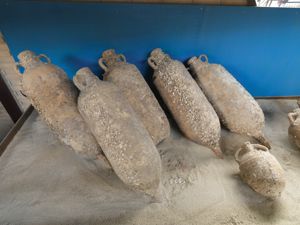
Studies have confirmed that, in the first centuries of the first millennium, most of the ports used for commerce were entrusted to the protection of a female deity in whose sanctuary it was not uncommon for sacred prostitution to take place. Archaeological investigations have testified that, even in the sanctuary present at the site of Cuccureddus, probably dedicated to the goddess Ashtart, this type of rite took place. In fact, in the still visible rooms of this building, numerous jars were found that originally had to contain perfumed ointments and a gargoyle depicting an abnormally large phallus.
In the immediate surroundings of the sanctuary, especially on the O side of the hill, private homes and warehouses used for storing and storing foodstuffs have also been found. In particular, in the S sector of the hill, there are four rectangular rooms aligned with each other, built with unsquare stones of various dimensions and arranged in a N/E-S/O direction.
These rooms appear delimited on the N/E front by a sort of crawl space consisting of medium and small stones, placed to integrate natural rock.
Around 540 BC, Cuccureddus was the victim of an attack by the Carthaginians, who burned it down. The settlement was abandoned and was no longer inhabited until the Roman conquest of Sardinia. The traces of the attack are particularly evident and the latter has paradoxically helped to keep the monument intact at the time of destruction. The fire has in fact cooked and preserved part of the ceilings and floors of the buildings, normally made of raw pressed clay.
History of excavations
Archaeological investigations began in 1983 by Piero Bartoloni and Luisa Anna Marras. The first phase of the research ended in the early 90s.
Bibliography
L.A. Marras, “Cuccureddus, The Phoenician Settlement”, in Proceedings of the Accademia Nazionale dei Lincei, XLII, fasc. 7-12, 1989;
L.A. Marras, “The Settlement of Cuccureddus and the Territory of Villasimius in Antiquity”, “Cuccureddus of Villasimius: from Ashtart to Juno”, in Phoinikes b Shrdn. The Phoenicians in Sardinia: new acquisitions, exhibition catalog (Oristano, Antiquarium Arborense, July-December 1997), curated by P. Bernardini-R. D'Oriano-P.G. Spanu, Cagliari, The Historical Memory, 1997, pp. 77-79, pp. 187-188; S. Moscati -P.
Bartoloni-S.P. Bondà, The Phoenician Punic Penetration into Sardinia Thirty Years Later, Rome, 1997.
How to get there
From Cagliari, take the road that runs along the Poetto beach to the junction for Villasimius, where you turn right. After traveling about 40 km, beyond Campus beach, in the direction of Campulongu, on the right you take a dirt road that goes up to the hill, where the remains of the settlement are located, currently accessible also from the beach below through two staircases that climb the sides of the first of the four hills that make up the complex.
Content type:
Archaeological complex
Archaeology
Usability: unmanaged site
Province: South Sardinia
Common: Villasimius
Macro Territorial Area: South Sardinia
POSTAL CODE: 09049
Address: via del Porto, s.n.c.
Update
Where is it


 Facebook
 Twitter
 LinkedIn
 Whatsapp

 Print
Print
 E-mail


Comments