Subjects





The town is located in Trexenta, of which in the past it was a center of considerable importance, as evidenced by the numerous archaeological remains. The Piscu Nuraghe is significant, of which one of the four towers is still intact. The landscape can be admired from the windows of the green train that, connecting Cagliari and Mandas, also crosses Suelli. The parish church of San Pietro Apostolo, inside the town, is adjacent to the sanctuary dedicated to Saint George, with which it communicates through the sacristy and the lower cell of the bell tower; in front is the small church of El Carmine.
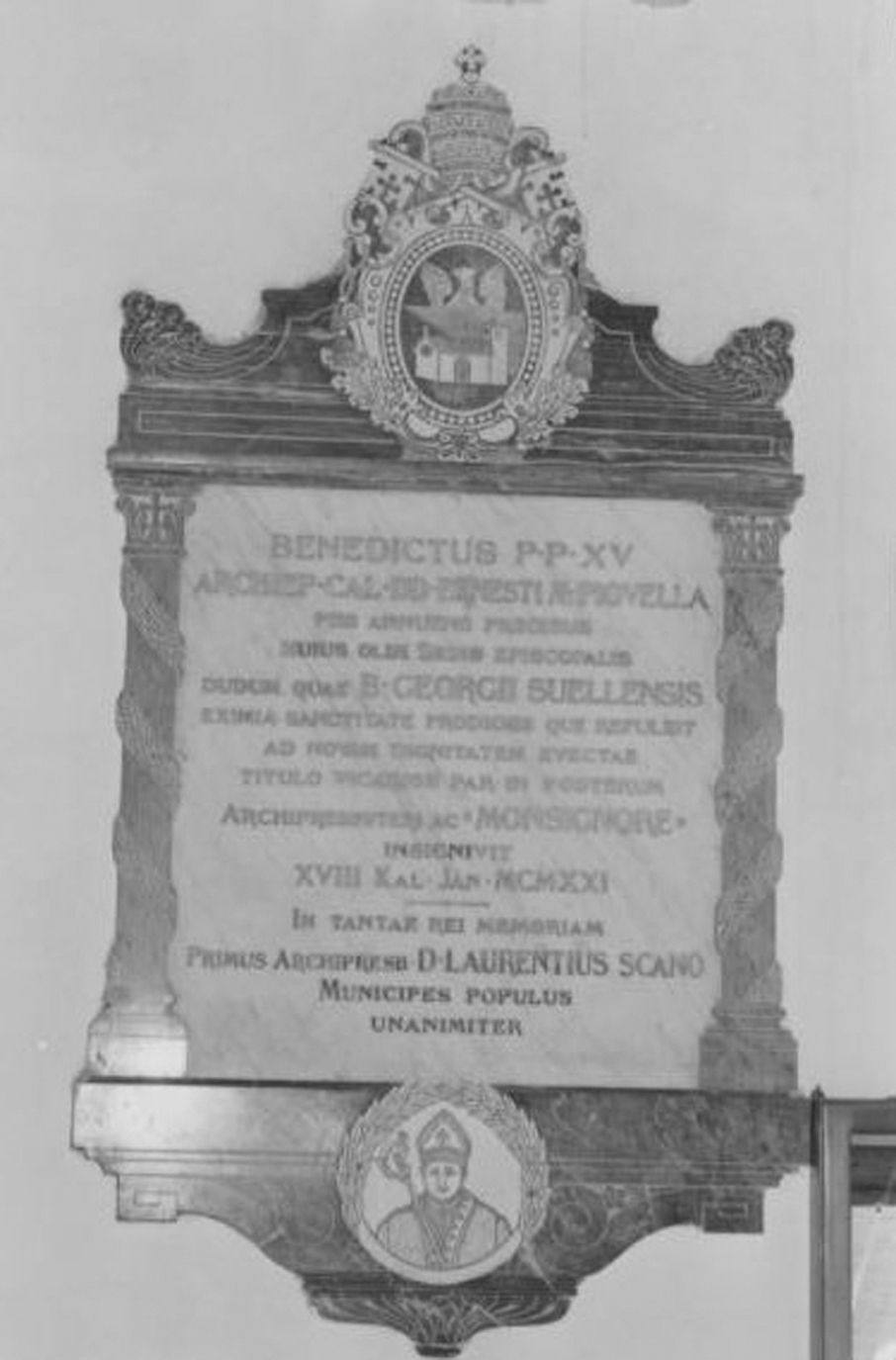
In medieval times, Suellis's “villa” was part of the Cagliari court and was included in the curatorship of the Trexenta. According to the “Provinciale Romanum”, Suellis was the suffragan seat of the Archdiocese of Cagliari. The patron of the parish church of San Pietro is San Giorgio, the first bishop of Suelli, attested in the first half of the eleventh century.
On the Romanesque church, the cathedral of Suelli, there are no parchment or epigraphic documents. The first mention of the title dates back to 1121-29, when Bishop Pietro Pintori, with the approval of the Cagliari judge Mariano-Torcotorio II de Lacon-Gunale, made public the donations made by private individuals “pro sanctu Petru de Suelli”. The building was rebuilt in the first half of the 13th century, as can be deduced from the formal analysis of the structures that still remain, the work of Tuscan workers active in Sardinia for the first time.
During the 16th century, the church was restored; the side chapels were built and the bell tower was raised. Only small parts of the external limestone masonry remain of the plant. In the façade, restored in 1869, the base, part of a portal ring, a jamb capital adorned with water leaves and caulicoli and the shapes of the parietal arcatelles remain.
The Romanesque factory probably had a plan with three naves, concluded by an S/E apse, which was later replaced by the late Gothic presbytery. The large façade (10.50 m) had to be divided into five mirrors, in which three portals opened. On the N side, a single-light window opens in which a front eagle is sculpted, which claws a hare.
The Romanesque building also contains the lower cell of the square-barreled bell tower, with a barrel vault resting on frames decorated with ovols and fuseroles and based on peducci sculpted with various motifs: classical, such as the one with ovoli and muzzles that incorporates the decoration of the frame, vegetable and zoomorphic. The bell tower was finished in the late Gothic era.
History of studies
building was taken care of by Raffaello Delogu, who placed the Romanesque construction in the first half of the 13th century and assigned it to Tuscan workers who had just arrived in Sardinia. The monument was also the subject of Renata Serra's attention, for whom the Romanesque façade, very large, had to be divided into five mirrors and accommodate three portals.
Bibliography
V. Angius, entry “Suelli”, in G. Casalis, Historical and Statistical-Commercial Geographical Dictionary of the States of His Excellency the King of Sardinia, XX, Turin, G. Maspero, 1850, pp. 519-520;
G. Spano, “Ancient Church of Suelli”, in Sardinian Archaeological Bulletin, IX, 1863, pp. 8-12;
D. Scano, History of art in Sardinia from the eleventh to the fourteenth century, Cagliari-Sassari, Montorsi, 1907, pp. 341-342; R. Delogu, The architecture of Middle Ages in Sardinia, Rome, The State Library, 1953, pp. 169 -170;
The Province of Cagliari. The Municipalities, edited by N. Sciannameo-F. Sardi, Cinisello Balsamo, Silvana, 1985 (II ed.), p. 282;
R. Serra, Sardinia, series “Romanesque Italy”, Milan, Jaca Book, 1989, pp. 353-355; R. Coroneo, Romanesque architecture from the middle of the thousand to the early '300, Nuoro, Ilisso, 1993, sheet 94;
R. Coroneo, Romanesque churches of Sardinia. Cultural tourist itineraries, Cagliari, AV, 2005, p. 89.
Content type:
Religious architecture
Province: South Sardinia
Common: Suelli
Macro Territorial Area: South Sardinia
POSTAL CODE: 09029
Address: piazza S. Pietro, s.n.c.
Update
Where is it
Suelli, Chiesa di San Pietro Images number: 2
Images


 Facebook
 Twitter
 LinkedIn
 Whatsapp

 Print
Print
 E-mail


Comments