Subjects





The town of Santa Filitica is in the municipality of Sorso, a few meters from the sea, on the coastline between the Silis and Pedras de Fogu rivers. The toponym of the area, known as Santa Filitica, refers to the holy African martyrs Felicita and Perpetua, whose cult is little attested in Sardinia.
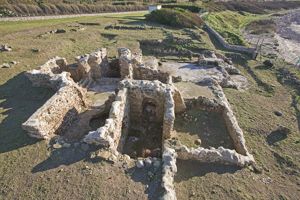
The complex consists of rooms of a Roman-imperial villa, which would represent the first phase of the plant, of a cruciform building reused as a place of Christian worship and of two distinct rustic villages from the Vandalic and Byzantine ages.
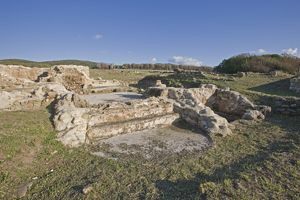
In the Roman villa, archaeological excavations have, for now, revealed a tank and some rooms, including a large rectangular room with a mosaic decorated floor (dated between the 3rd and 4th centuries AD), connected to smaller rooms and to a hexagonal shaped basin, probably related to a thermal system.
The discovery of parts of lamps and ceramics, which bear Christian symbols imprinted on them, such as crosses and crismons (5th-7th century), and the transformation of some rooms of the villa into a place of worship testify to the affirmation of Christianity. In fact, to the E of the mosaic room there is a small building with an apsed cruciform plan, oriented to S and with an entrance to N, preserved for most of the upper part, up to the first courses of the vault of the apse.
The structure must have been part of the thermal system of the Roman villa, given the presence of a bath with “suspensurae” and parietal cavities for the circulation of hot air in arm E. It is not, however, still clear if the apse and the N arm were part of the original system or were added later.
It is likely that, when the building stopped functioning as a spa, it was transformed into a place of Christian worship, at the service of the inhabitants of the small settlement.
The abandonment of the building dates back to the end of the 6th and the beginning of the 7th century, when the decking of the area was raised by alluvial sand. A new settlement is established on this level, consisting of dry stone masonry houses, terraced on four sides around the cruciform building, which in this phase is used as a burial place.
A lead bull by Pope Nicholas I (858-867), found in the N arm of the cruciform building, is pertinent to the last period of life of the Byzantine village, in a layer belonging to the last funerary phase of the place.
The settlement remained active until the full Byzantine period, as evidenced by the finds, which refer to relations with Africa, with the East and with northern Italy. Furthermore, craft activities related to the needs of the community are documented, such as weaving, the production of ceramics for common use and bone artifacts.
History of excavations
The beginning of archaeological investigations dates back to 1980. From 1982 to 1989, there were brief annual excavation campaigns. The research resumed in 1997.
Bibliography
D. Rovina, "Sorso (Sassari). Locality of Santa Filitica”, in Bulletin of Archaeology, 4, 1990, p. 135; C. Cossu-G.
Nieddu, Suburban Baths and Villas of Roman Sardinia, Oristano, S'Alvure, 1998, pp. 74-75;
P.G. Spanu, Byzantine Sardinia between the 6th and 7th centuries, Late Antique and Medieval Mediterranean series. Excavations and Research”, Oristano, S'Alvure, 1998, pp. 135-137;
The early medieval settlement of Santa Filitica (Sorso-SS): interventions 1980-1989 and excavation campaign 1997. Preliminary report, in “Medieval Archaeology”, XXVI, 1999, pp. 179-216;
P.G. Spanu, “The Christianization of the Rural Environment in Sardinia”, in Early Christian Sardinia between Eusebio and Gregory the Great. Proceedings of the National Study Conference, Cagliari, 1999, pp. 485-495;
D. Rovina, “Rural settlements between antiquity and the Middle Ages: the site of Santa Filitica”, in Archaeology and History of Medieval Sardaigne: Actualité de la Recherche: Actes de la Table Ronde de Rome, 14 and 15 November 1997, Rome, Ecole francaise de Rome, 2001, pp. 10-26; D. Rovina, “The Roman and Early Medieval Complex of Santa Filitica di Sorso (SS)”, in To Christi.
Primitive Christianity in Sardinia, Corsica and the Balearic Islands, edited by P.G. Spanu, Oristano, S'Alvure, 2002, pp. 519-523;
D. Rovina, “Sorso: the rural settlement of Santa Filitica”, in On the Borders of the Empire. History, art and archeology of Byzantine Sardinia, curated by P. Corrias-S. Cosentino, Cagliari, M&T Sardinia, 2002, pp. 183-186.
How to get there
Take the SS 200 (Sassari-Santa Teresa Gallura) to Sorso. From here, take the SP 130 to the sea.
Content type:
Archaeological complex
Archaeology
Usability: unmanaged site
Province: Sassari
Common: Sorso
Macro Territorial Area: Nord Sardegna
POSTAL CODE: 07037
Address: SS 200 - località Santa Filidiga
Update
Where is it
Images
Results 2 of 112230
View All
Video


 Facebook
 Twitter
 LinkedIn
 Whatsapp

 Print
Print
 E-mail

Comments