Subjects





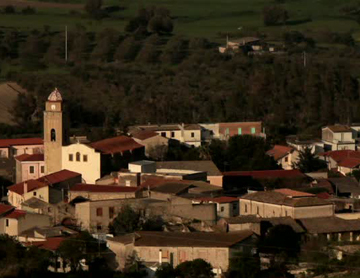
The territory of Sanluri has been intensely inhabited since prehistoric times. The battle that marked the end of the autonomy of the court of Arborea was fought here in 1409. The castle is home to the Medieval Castle Museum.
The structure currently visible was rebuilt and expanded, on a pre-existing one, around the middle of the fourteenth century at the behest of Peter IV of Aragon on the occasion of the peace between the Aragonese and the kingdom of Arborea.
In the 15th century, the castle first ended up in the hands of the De Sena family, then in those of D'Henríquez and finally the Aymerich of Laconi, who sold it only in 1836, when the feudal regime fell. In the 20th century, the new owner, General Nino Villasanta, renovated it and used it as a house-museum.
The Castle is located in a low position compared to the town. It has a quadrangular plan of about 27x27 meters, a height of 10 meters and crenellated semi-turrets, perhaps the result of two successive construction phases, it is implemented with limestone corners summarily cut out. From the entrance you can access the court of honor where you can find the stairs to access the main floor. Between the ground floor and the first floor, an environment was created used as a castle chapel. Over the centuries, the ownership of the Castle has changed. Until the twenties of the twentieth century, when Nino Villa Santa, an army officer and member of the General Staff of the Duke of Aosta, bought it and allocated it partly to a residence and partly to the Museum of the Risorgimento.
History of studies
For the castle of Sanluri, you can consult the series of studies by Gabriella Olla Repetto: the first, from 1959, entitled “The castle of Sanluri under Aragonese domination”, the second, “The castle of Sanluri in the 14th and 15th centuries”, from 1965, the third “The origin of the castle of Sanluri”, from 1973. Also useful is the contribution included in Foiso Fois's volume on the castles of medieval Sardinia, in 1992, as well as the article by Elena Lai in 2003.
Bibliography by
G. Olla Repetto, “The castle of Sanluri under Aragonese domination”, in the Sardinian Historical Archive, 26, 1959, pp. 161-187;
G. Olla Repetto, The Castle of Sanluri in the 14th and 15th centuries, Cagliari, 1965; G. Olla Repetto, The origin of the castle of Sanluri, Cagliari, 1973;
F. Fois, Castles of medieval Sardinia, edited by B. Fois, Cinisello Balsamo, Amilcare Pizzi, 1992, pp. 85-90;
F. Segni Pulvirenti - A. Sari Architecture, Late Gothic and influential renaissance. Nuoro, Ilisso, 1994, sheet 15;
E. Lai, “The use of the “Serrenti Stone” in the castle of Sanluri”, in Roccas: aspects of the fortification system in Sardinia: proceedings of meetings on castles in Sardinia (2002) by the Arxiu de Tradicions, edited by S. Chirra, Oristano, 2003, pp. 55-60; G. Serreli, All the castles of the four kingdoms, “Darwin. Notebooks”, n. 1 (July-August 2006), pp. 104-109.
Content type:
Fortified architecture
Province: South Sardinia
Common: Sanluri
Macro Territorial Area: South Sardinia
POSTAL CODE: 09025
Address: via Generale Nino Villa Santa, 1
Telephone: +39 070 9307184 +39 393 9916135
E-mail: castellodisanluri11@tiscali.it
Website: www.castellosanluri.it/il-castello
Facebook: it-it.facebook.com/castellosanluri
Update
Where is it
Images
Texts


 Facebook
 Twitter
 LinkedIn
 Whatsapp

 Print
Print
 E-mail



Comments