Subjects





Monserrato is located in the Campidano area of Cagliari, about 5 km N/E from the capital.
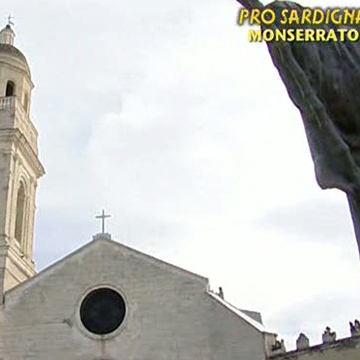
The parish church of Monserrato, named after Sant'Ambrogio, belongs to the group of buildings that can be traced back to the Catalan Late Gothic period in its Sardinian variant.
In plan, the building has a single nave with six chapels on each side and a square-shaped presbyterial chapel narrower than the classroom.
The façade is characterized by the cusped terminal façade in which an arched portal opens, whose triple trumpet is given by columns surmounted by sculpted cylindrical pseudo-capitals; the pointed arch is further framed by an eyebrow that unloads on peducci with a phytomorphic decoration. Above the portal is a bull-shaped oculus. Particular and unique in Sardinia is the shape of the diagonal buttresses on the façade, along whose lines, crenellated crowns have been created. The nineteenth-century square-barreled bell tower aligns with the façade on the s., above the first chapel, now padded.
Inside, the classroom is covered by a broken barrel vault punctuated by five pointed arches that rest on the side buttresses through pilasters. The chapels, overlooking the aisle through pointed arches, have a barrel roof to replace the original ribbed and gemmed cross vaults; in recent times, the seven walls between one chapel and the other have been opened, thus obtaining a classroom effect with three naves. The presbyterial area, lower than the aisle, is covered by a simple stellar vault.
The construction of the church, first hypothesized stylistically and then supported by documentary sources, dates back to the second half of the 16th century: in a notarial minutes from 1564, the dean of the cathedral of Cagliari and preblessed by Pauli de Pirri (historical name of Monserrato) Don Geronimo Zapata, together with the mayors of the villa, came to terms with the picapedrers (stonemasons) Gaspare, Pierotto, Giovanni Antonio Barrai (a well-known family of picapedrers operating in the second half of the 16th century Meridione dell'Isola) and Giovanni Vacca by Cagliari for the construction of the “cap d'altar” of the parish church yet to be built. From another document from 1615, we learn that in that year the construction of the two walls on the sides of the façade was commissioned, which should have had a horizontal and crenellated terminal as their façade. In 1619, the bell tower factory began, whose collapse, which occurred between the last decade of the 18th century and the first two of the 19th century, involved the reconstruction of the façade in its current sloping form.
The chapels, as happened in many other churches on the island, were opened at later times: one, dedicated to Saints Cosma and Damiano, was under construction in 1569; two, dedicated respectively to the Most Holy Crucifix and to Santa Barbara, are mentioned in the inventory drawn up in 1599 on the occasion of the pastoral visit of Archbishop Lasso Sedeño; by 1607 the chapel dedicated to San Diego was erected, while for the remaining chapels they can be considered to have been built within the third decade of the seventeenth century, all of which were in existence at the time of Archbishop Machin's visit in 1629.
History of studies
The church is the subject of in-depth study in an article by Aldo Pillittu (1991).
Bibliography
R. Serra, “The parishes of Assemini, Sestu and Settimo San Pietro. Notes for a history of late Gothic architecture in Sardinia”, in Proceedings of the XIII Congress on the History of Architecture (Sardinia), I, Rome, 1966, pp. 225-243; S. Agus, Monserrato. A Story Without History, Cagliari, Kalb, 1988;
M. Vincis, A Look at the Past. Historical research on Monserrato, Cagliari, Trois, 1989;
A. Pillittu, “A Sardinian late Gothic monument: the parish church of Sant'Ambrogio in Monserrato”, in Studi Sardi, XXIX, 1990-91, pp. 405-425;
S. Agus, Art and religion in Monserrato, Dolianova, Grafica del Parteolla, 1996; S. Mereu, “For a history of the Tardogothic in southern Sardinia: new acquisitions and archival documents”, in Studi Sardi, XXXI, 1994-98, pp. 1-486.
Content type:
Religious architecture
Province: Cagliari
Common: Monserrato
Macro Territorial Area: South Sardinia
POSTAL CODE: 09042
Address: via Giuseppe Zuddas, s.n.c.
Website: https://www.comune.monserrato.ca.it/pagina1081_parrocchia-di-santambrogio.html
Update
Where is it
Video


 Facebook
 Twitter
 LinkedIn
 Whatsapp

 Print
Print
 E-mail


Comments