Subjects





The church is at the southern end of the Villanova district, in an area formerly occupied by a Roman and late ancient necropolis, not far from the Basilica of San Saturnino and overlooking a large square.
In the counter-reformist climate of the search for the “Holy Bodies”, between 1646 and 1692, the church of San Lucifero was erected in Cagliari, at the expense of the Municipality and some private individuals.
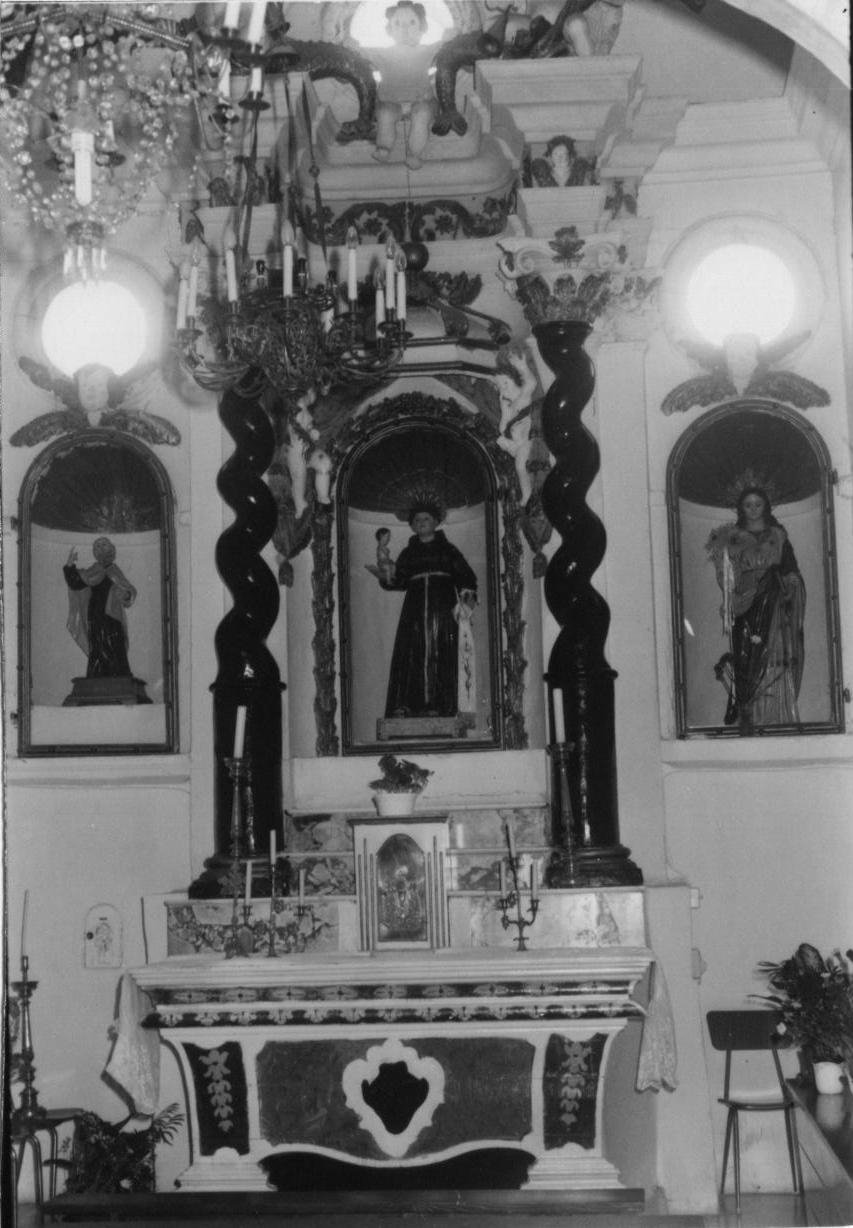
Built on the Christian necropolis where the saint's tomb would have been found, it takes up the pattern of counter-reformed churches, imported into Sardinia by the Jesuits, with a single aisle marked laterally by three chapels on each side and concluded by a large transept overlooking the square presbytery of the same width as the transverse arms. Covered with barrel vaults supported by a tall protruding entablature and notched on Doric pilasters, it has a pavilion-like dome on an octagon drum at the intersection of its arms. The high presbytery, which is accessed through a staircase covered with Spanish school tiles, rises above the late-antique crypt.
Equally austere is the façade, finished flat and framed by Doric pillows on which rests a thin entablature that divides it in two orders: the upper one includes a central oculus and two rectangular windows on the sides. The lower part of the façade is barely moved by the portal dated 1692, enclosed in bare granite columns on which rests an architrave with curled side volutes surmounted by two small stone dogs, referring to the Order of the Dominicans who officiated the church until 1769. The marble emblem of the city of Cagliari is located in the mezzeria.
The church, based on the canons of an austere Mannerism derived from the vineyard, opposed to a certain already baroque emphasis on entablature and volute keys, seems to depend stylistically on that same Domenico Spotorno, executor of the Jesuit churches of San Michele di Alghero and Sant'Ignazio di Oliena and who, from 1669 to 1674, had been responsible for the renovation of the cathedral of Cagliari and, from 1681 to 1686, that of Ales.
History of studies
The church is the subject of a brief fact sheet in the volume by Francesca Segni Pulvirenti and Aldo Sari on late-Gothic and Renaissance-influenced architecture (1994).
Bibliography by
F. Segni Pulvirenti - A. Sari, Late Gothic and Renaissance-influenced architecture. Nuoro, Ilisso, 1994, sheet 63.
Content type:
Religious architecture
Province: Cagliari
Common: Cagliari
Macro Territorial Area: South Sardinia
POSTAL CODE: 09125
Address: via San Lucifero, s.n.c.
Update
Where is it
Images
Texts

Author : Pius IX <papa>
Year : 1855
Author : Zasso, Gino
Results 2 of 1405091
View All


 Facebook
 Twitter
 LinkedIn
 Whatsapp

 Print
Print
 E-mail

Comments