Subjects





The avenue borders on E the historic district of Marina. The area stretches between Via Cavour and Via dei Pisani.
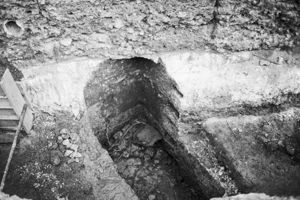
In the area, the remains of a complex with an N/E-S/O trend, partly underground, partly covered in wood, came to light, as the substantial layer of burning found during the excavation would suggest.
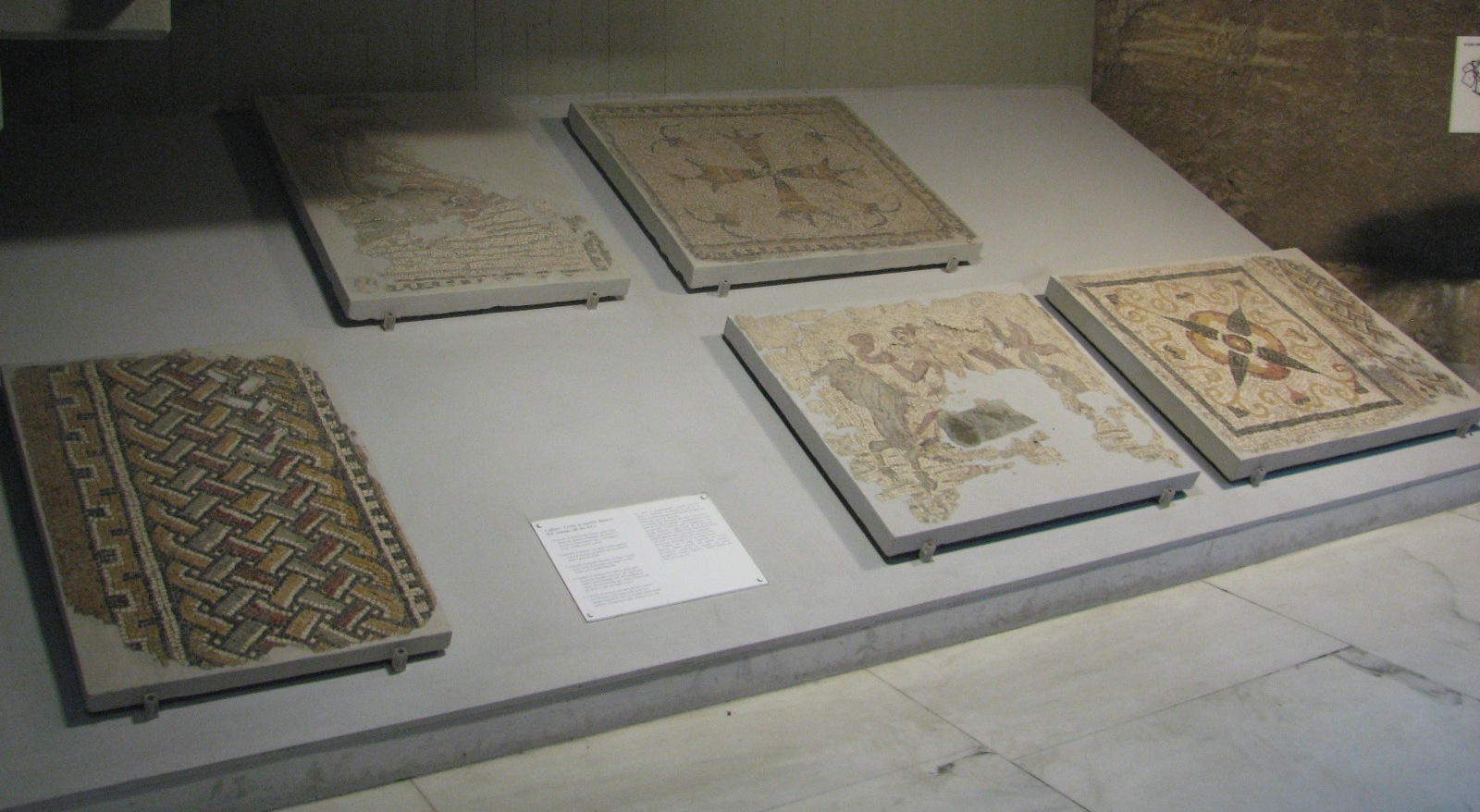
The building consisted of a sort of porch with a mosaic floor and columns and a rectangular room with side apsidioles, closed in N by an apse. This floor was 1.30 m higher than the rest of the room and was covered with reused, polychrome and large marble slabs. In the center of the apse there was a small square-shaped tub, with a concave bottom and short shoulder straps made of reused materials. In the bottom and in the walls, there were traces of mosaic, small marble tiles and vitreous paste.
This apse was originally a large tank, to be connected to the Roman aqueduct of the 2nd century AD. Subsequently, the tank was cut and connected to others, which were also modified in function and appearance. The ensemble was integrated with brick, stone and block structures.
The complex probably extended towards the center of the street and towards the Marina district. It was located in an area with a strong funerary vocation in the late Punic and Roman ages. Considering that in Sardinia, cemetery areas have often played a polarizing role in the activation of the first church systems, the structures of Viale Regina Margherita could be interpreted as pertinent to a cemetery basilica, even if this hypothesis is not supported by any tradition.
The complex suffered a fire and collapse when it had already undergone a downgrade, since part of the floor had been stripped of the marble coating and walls had been built that had altered its appearance. As for the small mosaic decorated bathtub placed in the floor of the apse, it is not possible to say with certainty if it was a baptismal bath or a reliquary.
It is assumed that the initial phases of the complex are to be assigned to a period between the 4th and 5th centuries AD, while the definitive abandonment should have occurred in the 7th century A.D.
History of the excavations
The excavations were conducted in July 1981 by Marie Antoinette Mongiu.
Bibliography
M.A. Mongiou, “Urban Forms Addendum. Late antique and early medieval elements in Cagliari in the light of recent excavations”, in Early Christian and Early Medieval Sardinia. Recent studies and research, Cagliari, 1988, pp. 63-88;
M.A. Mongiu, “The neighborhood between myth, archeology and urban design”, historic districts in Cagliari: Marina, Cagliari, 1989, pp. 13-22.
How to get there
Viale Regina Margherita connects the end of Via Roma with Piazza Costizione.
Content type:
Archaeological complex
Archaeology
Usability: unmanaged site
Province: Cagliari
Common: Cagliari
Macro Territorial Area: South Sardinia
POSTAL CODE: 09125
Address: viale Regina Margherita, s.n.c.
Update
Where is it
Texts

Author : Pisapia, Maria Stella
Author : Pisapia, Maria Stella
Results 2 of 1438215
View All


 Facebook
 Twitter
 LinkedIn
 Whatsapp

 Print
Print
 E-mail
Comments