Subjects





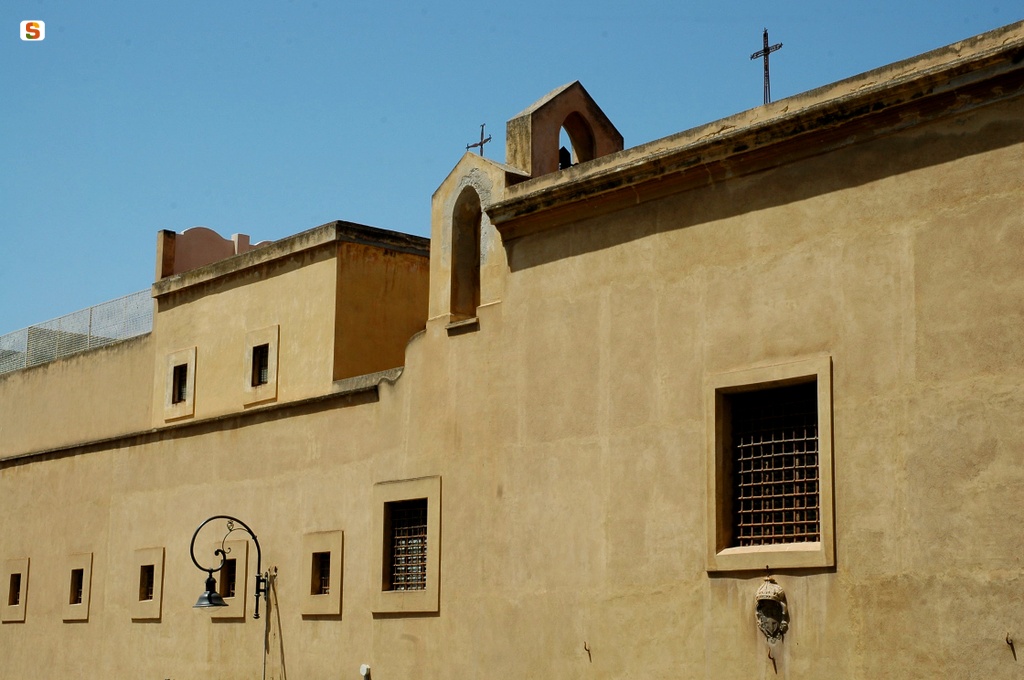
The cloistered monastic complex of the Clarisse Cappuccine is located on the corner with Via Giovanni Spano, the ancient Via dei Tornitori in the Marina district and occupies the highest area of the neighborhood above sea level, as well as adjacent to the late-medieval castle.
The institution of the religious order of Clarisse nuns dates back to 1212 and dates back to the will of Francis of Assisi. In 1538, the Order adhered to the Capuchin reform, consisting in strict observance of the rule of Saint Clare and the adoption of the dress and customs of the Capuchin Minors. In 1703, the Capuchins arrived in Cagliari, where they were housed in the Castello district until, in 1705-1711, the church and the adjoining monastery, dedicated to the Holy Sepulchre, were built on the site hitherto intended for public executions but used, already in the early Middle Ages, as a place of worship. In 1714, the convent was awarded the prerogative of royal monastery with the diploma of Charles III of Habsburg emperor of Austria, a title confirmed in 1733 by Carlo Emanuele III of Savoy. The church was instead consecrated and dedicated to the Blessed Virgin of Piety only in 1806. Following the interruption of Savoy donations and the first law to suppress religious orders enacted in 1855, the monastery was forfeited by the State Property and submitted to the administration of the Fund for Worship. The second suppression law of 1866 sanctioned the transfer to the Municipality or Province of buildings that belonged to suppressed congregations, in order to host public or charitable institutions. In 1895, therefore, the municipal authority decided to transform the monastery into a popular school, but the Worship Fund did not grant permission. The same refusal was subsequently up to the Finance Authority interested in transferring its offices to it, until in 1927 the convent was purchased by the Province, which in 1929 sold it to the Cagliari Real Estate Company, which left the church open for worship before donating the entire complex in 1962 to the Sardinian Province of the Capuchin Minors, who finally returned it to the Capuchins in 1969.
With its unadorned architecture in accordance with the ideology of the religious order, the church shows a simple rectangular environment, has a single aisle that crosses the first two bays, supporting a choir shielded by a sturdy iron grate. The remaining part of the classroom, on the other hand, is barrel-vaulted, set on a frame with a strong projection punctuated by undercuts discharging on pilasters from composite capitals; there are also two chapels facing half the length of the aisle; the back wall has, finally, a kidney-shaped window. The interior decoration is stucco and the floors are marble; the presbytery is raised slightly, only by one step, and through two symmetrical openings on the sides of its back wall, you can access the sacristy compartment, also rectangular, which has a corridor on the left connecting with a small room. The façade, crowned with a protruding frame, shows a rectangular opening and an additional, larger window, functional to the lighting of the choir, which belongs exclusively to the nuns. The portal is surmounted by the marble coat of arms of the House of Savoy, which features a flat silver cross in a red field, a type that replaced in 1766 at the behest of Charles Emmanuel III of Savoy the four poles of Aragon on a gold background of the Spanish government. However, the emblem may have been embedded in the wall in 1733, when the above-mentioned sovereign confirmed the royal title to the monastery. A sailing bell tower adorns the exterior, characterized by an extruded roof with tiles and tiles and by masonry, built in stone and bricks, with smooth plaster. The church underwent a first major restoration in 1718-1722, following the bombing by Cardinal Alberoni's fleet intent on reconquering the island from the Spanish monarchy, taking it away from Austria. On the other hand, an expansion was necessary in 1738, while a further restoration probably took place in 1793-1806. Certainly around 1935 the church was restored again and the two previously existing lunettes at the back of the room on the right wall were changed into the current windows, in order to increase the brightness of the interior.
Bibliography by
G. Spano, Guide to the city and surroundings of Cagli ari, Cagliari, Timon, 1861;
G. Da Riano, The Capuchin Nuns in Cagliari. Historical and Biographical News, Cagliari, S. Giuseppe Typography, 1938;
J. Arce, Spain in Sardinia. Cultural contributions and testimonies of his influence, Cagliari, T.E.A., 1982;
M. Pintus, “Architecture”, in Cagliari Historical Districts. Marina, Cinisello Balsamo, Silvana, 1989;
M.A. Mongiu, “Stampace: a neighborhood between polis and chora”, historic districts in Cagliari. Stampace, Cinisello Balsamo, Silvana, 1995;
M. Dadea - S. Mereu - M.A. Serra, Archdiocese of Cagliari, series “Churches and sacred art in Sardinia”, Cagliari, Zonza, 2000;
M.A. Mongiu, “The missed and possible opportunities of a long-term city”, in Cagliari between past and future, edited by G.G. Ortu, Cagliari, CUEC, 2004.
Content type:
Religious architecture
Province: Cagliari
Common: Cagliari
Macro Territorial Area: South Sardinia
POSTAL CODE: 09124
Address: scalette Monache Cappuccine, s.n.c.
Update
Where is it
Video


 Facebook
 Twitter
 LinkedIn
 Whatsapp

 Print
Print
 E-mail



Comments