Subjects





The church of San Gregorio is in the historic center, corresponding to the upper part of the town of Sardara. On the site there was a Nuragic sanctuary with a well temple near the church of Sant'Anastasia. Traces of Punic and Roman settlements remain in the territory. In the town of Santa Maria is Acquas, a Roman station was located along the main road connecting North and South of the island. The presence of spring water determined the installation of thermal baths, which are still active today. In judicial times, the territory was guarded by the castle of Monreale, on the border between the kingdom of Cagliari and that of Arborea.
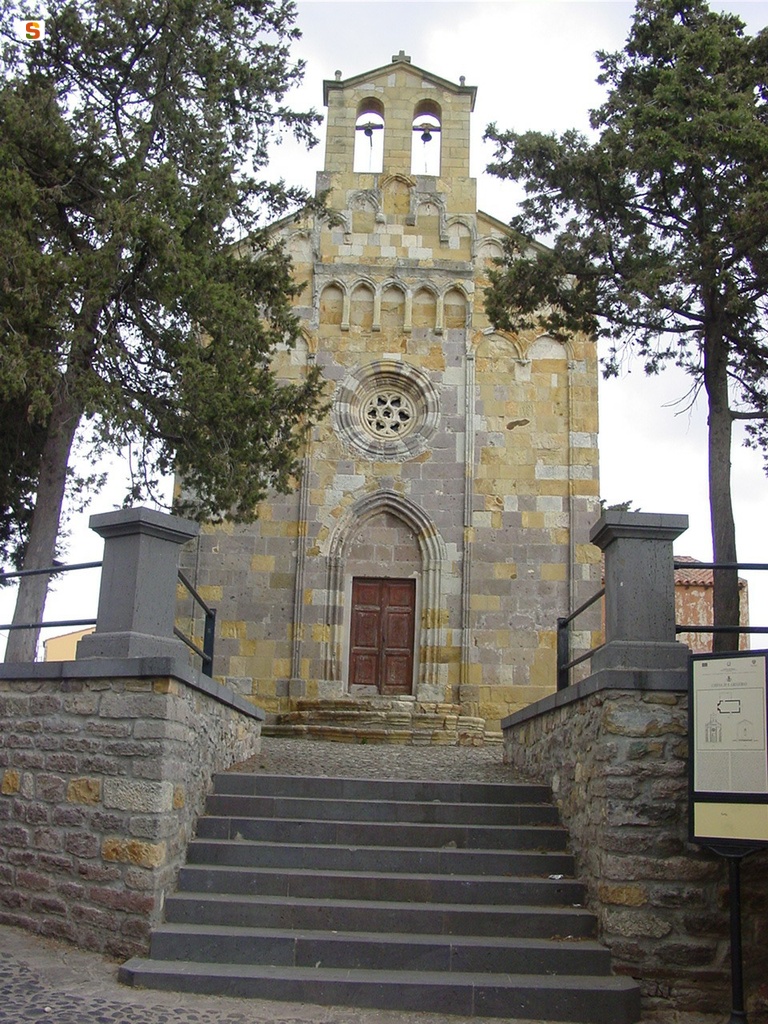
The church of San Gregorio, characterized by refined architectural details, is one of the most intact and significant Gothic monuments in Sardinia.
Although there is no documentary evidence, the factory can be attributed to the first quarter of the 14th century. The walls are made of limestone and volcanic stones. The floor plan is mononave with a wooden roof and an S/E shaped apse. The latter, despite having a semicircular profile inside, is externally square. This is a compromise solution between the deep-rooted Romanesque tradition and the intention to adhere to the new Italian Gothic forms.
The gabled façade is divided into three mirrors by beam pilasters and two sturdy corner pilasters. In the central mirror, the architraved portal opens, surmounted by an ovival exhaust arc and equipped with molded jambs. In line with the portal, a Gothic rose window opens, surmounted by a series of arches on peducci. The sailing bell tower with two narrow lights concludes the prospectus.
On the northern side, there is a portal with an acute arched curtain. In the apse there is an arched open window, much compensated for in the restorations.
History of studies
The church is mentioned by Vittorio Angius (1849) and Giovanni Spano (1868). The first historical and artistic researches are by Dionigi Scano (1907) and Raffaello Delogu (1953). The most recent contribution comes from Roberto Coroneo (1993).
Bibliography
V. Angius, entry “Sardara”, in G. Casalis, Historical and Statistical-Commercial Geographical Dictionary of the States of His Excellency the King of Sardinia, XX, Turin, G. Maspero, 1849, p. 901;
G. Spano in A. Della Marmora, Itinerary of the Island of Sardinia, Cagliari, Alagna, 1868, p. 264, note 2;
D. Scano, History of art in Sardinia from the 11th to the 14th century, Cagliari-Sassari, Montorsi, 1907, pp. 418-419; R. Delogu, The architecture of the Middle Ages I was in Sardinia, Rome, the State Library, 1953, pp. 234-234;
R. Coroneo, Romanesque architecture from the middle of the thousand to the early '300, Nuoro, Ilisso, 1993, page 164; Roberto Coroneo, Romanesque churches of Sardinia. Cultural tourist itineraries, Cagliari, AV, 2005, p. 82.
Content type:
Religious architecture
Province: South Sardinia
Common: Sardara
Macro Territorial Area: South Sardinia
POSTAL CODE: 09030
Address: piazza San Gregorio, s.n.c.
Update
Where is it
Sardara, Chiesa di San Gregorio Images number: 2
Images


 Facebook
 Twitter
 LinkedIn
 Whatsapp

 Print
Print
 E-mail



Comments