Subjects




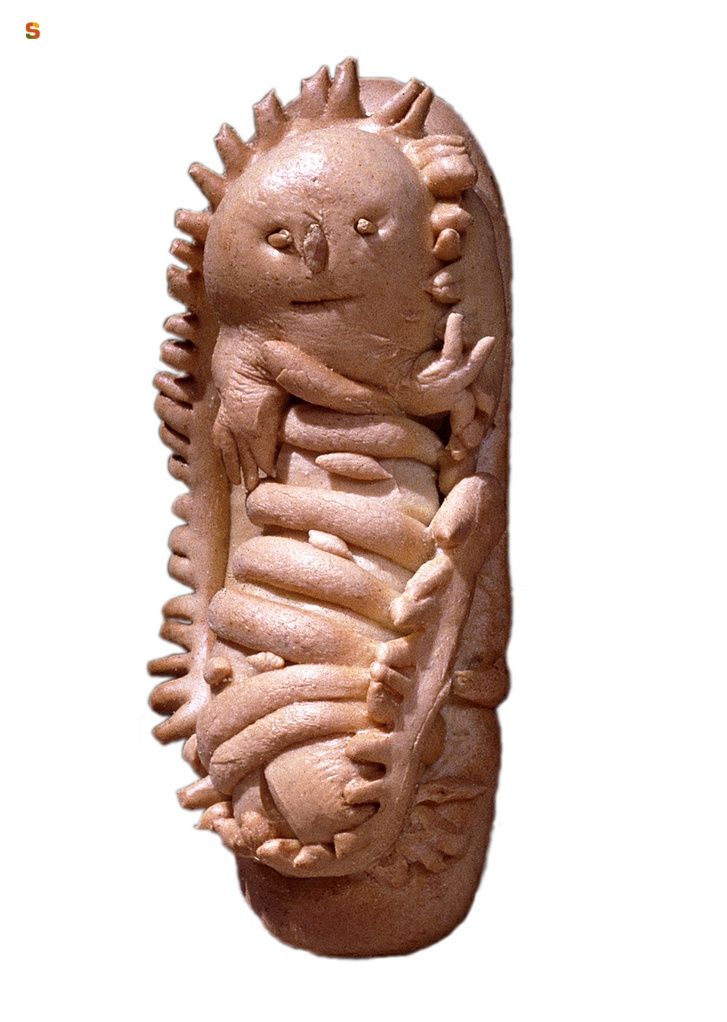
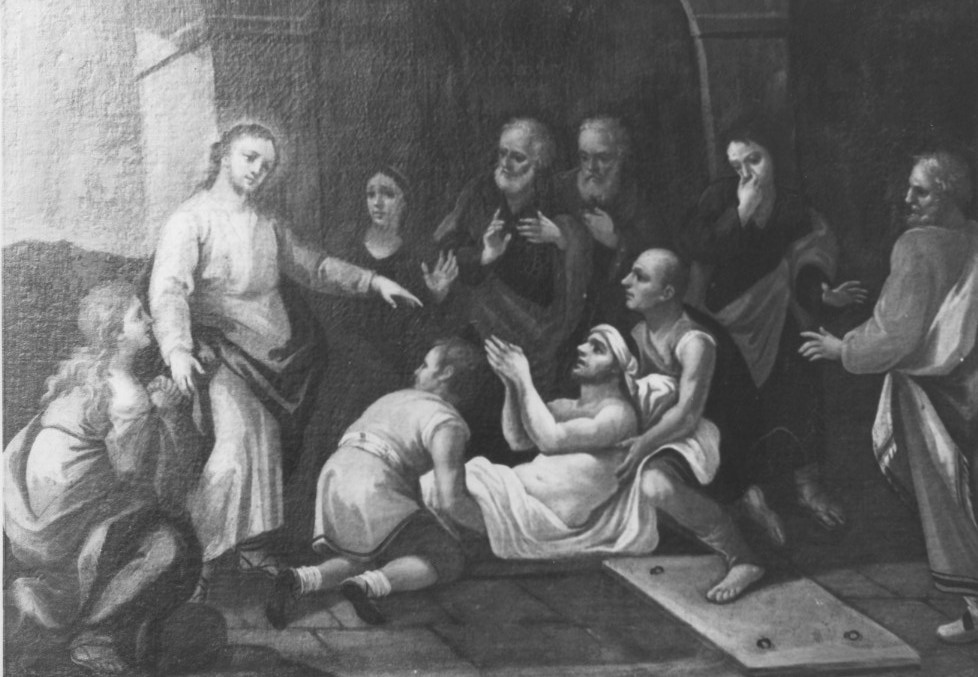
Another anthropomorphic bread, as Pipia 'e Carèsima knows, but with a masculine appearance, was on Làzaru or Lazareddu. His name and related figurative characteristics, lying in a supine position, wrapped in bandages, in some variants with signs of decomposition (represented by worms), refer to the evangelical figure of Lazarus (Jn 11:1 - 44). The resurrection of Lazarus of Bethany, four days after his death, is the last miracle performed by Jesus before being arrested and sentenced to the capital torture of the crucifixion. A fraternal friend of Lazarus and his sisters, Martha and Mary, Jesus, having arrived in Bethany, went to the tomb and, having removed the stone that closed it, called out with a loud voice to the deceased, ordering him to come out of the tomb. Lazarus came out of the tomb, still wrapped in funeral bandages. Jesus ordered that he be freed from the latter (symbol of the snares of death) and that he be let go, free to return to life.
Some scholars, while recognizing the uncertain destination of this Lenten bread, argue that it was probably a bread for children. In the Villaurbana (OR) version, Lazareddu, packaged for children, had two grains of wheat instead of eyes, the body wrapped in bandages, with signs of decay. It is clear, however, that in addition to the fact that it was dedicated to children, Su Làzaru has a symbolic charge of such importance during Lent that it can certainly be placed among ceremonial and ritual breads. On the contrary, due to the symbolic and ideological significance it contains, it can be considered that Làzaru represents one of the most profound historical and cultural ritual elements of Lent in Sardinia, and it is significant that the art of baking, which the anthropologist Alberto Mario Cirese defined as the “main cultural specialty of the Sardinians”, gives expression to this value.
The miracle of Lazarus's resurrection is not only a sign of the divine power that overcomes death, irrefutable proof of the superhuman nature of Christ (as emphasized by the first Christian authors, such as Tertullian and Augustine), but it is the very prefiguration of the death and Resurrection of the God made man.
Despite the stylization of the extremely simplified representation in bread dough, Lazarus with two grains of wheat instead of his eyes and, as mentioned, with the depiction of the signs of death (vermicelli modeled in an extremely simplified way) is also functionally combinable with su nènniri, wheat sprouted in the dark, like Lazarus and Jesus in the tomb. Is nènniris were pots containing wheat sprouts as pale as death, but at the same time a sign of life that affirms itself despite the darkness, which unfailingly adorned the Sepulchres, the altars of the Reposition, on Holy Thursday.
(Cover image: “Lazzareddu”, Villaurbana. Photo archive (ISRE)
Update
Images
Video


 Facebook
 Twitter
 LinkedIn
 Whatsapp

 Print
Print
 E-mail


Comments